Why Most AI Voicebots Sound Robotic
Businesses have long dreamed of AI voicebots that can handle outbound sales, customer service, and appointment reminders at scale without the limitations of human agents. The promise is clear: lower costs, 24/7 availability, and consistent quality.
Yet for many enterprises, the reality falls short. Customers hang up in frustration. Conversion rates stall. And the voicebot ends up sounding like just another robotic IVR system.
Why do so many AI voicebots fail to deliver a natural, engaging experience? And more importantly, how can enterprises deploy voice AI that actually sounds human, connects emotionally, and drives real business results? The answers lie not in simply adding more automation, but in rethinking how voicebots understand language, adapt to context, and express emotion.

The Voicebot Gap: Why Automation Fails to Convert
Most voicebots today rely on rigid decision trees and basic speech recognition. They follow predetermined scripts, struggle with unexpected responses, and ignore the emotional state of the customer. The result is an interaction that feels mechanical, frustrating, and ultimately ineffective.
Consider the challenges:
• Lack of emotional intelligence. Human conversations are rich with emotional cues—frustration, hesitation, excitement. Traditional voicebots can't detect these signals, so they plow forward with the same script, ignoring when a customer needs empathy or a different approach.
• Inability to handle interruptions. Real conversations are messy. People interrupt, pause, change their minds. Most voicebots can't handle this fluidity, leading to awkward silences or the bot talking over the customer.
• Generic, monotonous delivery. Even when the words are correct, a flat, robotic tone destroys engagement. Customers instinctively distrust a voice that lacks warmth and personality.
These gaps explain why so many voice AI initiatives fail to deliver on their ROI promises. Conversion rates remain flat, customer satisfaction drops, and operational teams are left manually reviewing thousands of calls to figure out what went wrong.
The Instadesk Difference: Voice AI That Feels Human
Instadesk was built from the ground up to solve these exact challenges. Our voicebot combines large language models, emotional intelligence, and deep localization to create conversations that customers actually enjoy.
1. True Multilingual, Multi-Dialect Fluency
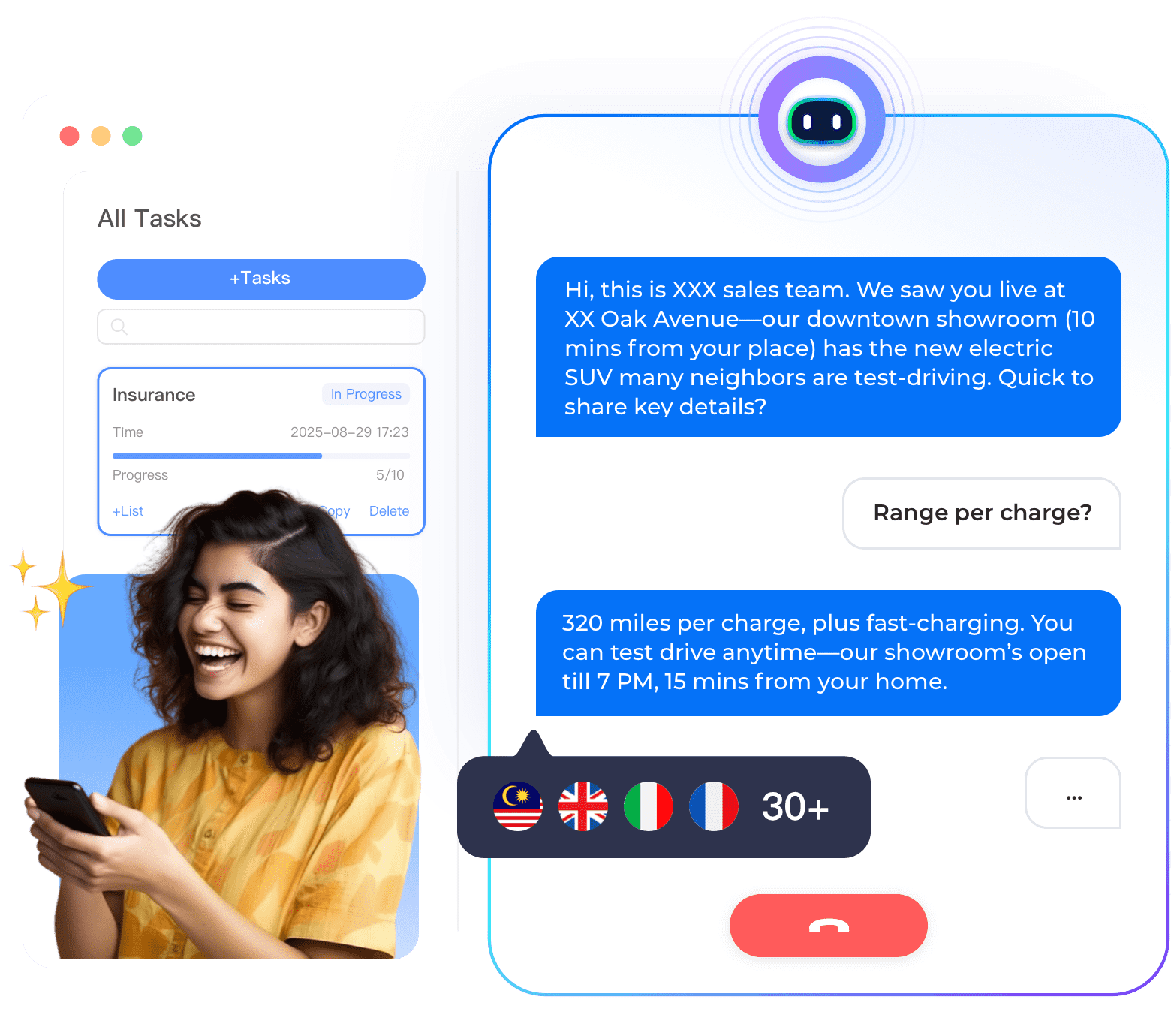
A voicebot that only works for one accent or language is a non-starter in today's global economy. Instadesk's voicebot is powered by large-model technology that provides natural conversation recognition across more than 30 languages, including bilingual support for markets like Malaysia where customers seamlessly switch between Malay and English.
Our ASR models are trained on regional dialects, so whether a customer speaks with a Northern Chinese accent or a British inflection, the voicebot understands. This deep localization directly translates to business results: financial and technology clients using Instadesk for outbound marketing have seen conversion rates increase by over 30%.
2. Emotional Intelligence That Builds Connection
Understanding words is one thing. Understanding feelings is another. Instadesk's voicebot continuously assesses the customer's emotional state—detecting frustration, hesitation, or enthusiasm and adapts the conversation in real time.
If a customer sounds confused, the bot slows down and offers clarification. If a prospect shows interest, the bot leans in with more persuasive language. This emotional responsiveness makes interactions feel genuinely human, not scripted.

3. Natural Interruption Handling and Real-Time Adaptation
In real conversations, people interrupt, repeat themselves, or go silent. Instadesk's voicebot is designed for this reality. It can be interrupted and respond within two seconds, pausing its broadcast and picking up seamlessly when the customer finishes. It handles silences intelligently, knows when to for more information, and can circle back to earlier topics without losing context.
This dynamic capability transforms the caller experience. Instead of fighting the bot to be heard, customers feel like they're talking to a capable, attentive human.
4. Voices With Emotion and Personality
A voicebot's tone matters as much as its words. Instadesk allows enterprises to infuse voices with emotional elements—warmth, urgency, empathy—by recording and uploading live voice samples. The bot mimics the intonation and pacing of a real person, creating a personalized voice that reflects the brand's identity.
The result? Customers stay on the line longer. Call duration increases naturally because the interaction feels engaging, not transactional.
5. Zero-Code Orchestration for Rapid Iteration
Even the best voicebot needs continuous improvement. Instadesk's visual orchestration interface lets business teams build, test, and update voicebots without writing a single line of code. Standardized templates across eight industries and 46 pre-built dialogue sets accelerate time-to-value from months to days.
When market conditions change or new scripts are needed, teams can update the voicebot in real-time using natural language commands. The platform automatically tags conversation content, extracts customer insights, and diagnoses failed interactions, enabling rapid tuning without manual call review.
The New Standard for Voice AI
The question is no longer whether voice automation can handle simple tasks. It can. The real question is whether your voicebot can deliver experiences that customers actually want: conversations that feel human, adapt to context, and build genuine connection.
Instadesk's approach proves that emotional intelligence, multilingual fluency, and rapid iteration are not optional extras. They are the essential ingredients for voice AI that converts, satisfies, and scales.
When enterprises deploy voicebots that sound robotic, they waste investment and damage brand perception. When they deploy Instadesk, they gain a competitive advantage: one conversation at a time.
This is why leading businesses are choosing Instadesk: because voice AI should sound like the best of human interaction, not the worst of automation.
Tags
Share This Article



Instadesk
Instadesk official
You may also like

From Missed Calls to Instant Answers: How Instadesk VoiceBot Empowers Healthcare and Life Sciences
In healthcare, every missed call can mean a delayed appointment, a medication question left unanswered, or a patient's anxiety left unaddressed. Traditional phone systems simply cannot handle the volume, especially after hours or during peak flu seasons. That is why leading healthcare providers are turning to the VoiceBot Inbound Call solution from Instadesk.


How Game Companies Choose the Right AI Solution: Comparison & Case Studies
This guide helps game companies select the right AI solution by exploring gaming AI’s unique requirements, comparing common models, sharing real case studies, highlighting pitfalls to avoid, and outlining a step-by-step selection process to unlock real operational value.


5 Key Pain Points in the Gaming Industry: How to Use AI to Serve Your Gamers Effectively
This article explores five critical pain points in the gaming industry, explains the shift from basic chatbots to next-gen AI services, outlines high-impact AI workflows, and provides actionable steps to operationalize AI for better gamer service and business growth.
Get Started in Minutes. Experience the Difference.