Is Your Customer Service Team Buried in Repetitive Questions? A Guide to AI Automation
It's 9 AM. Your customer service team logs in to find 200 new tickets. Fifty are asking "where's my order?" Another forty want to know "how do I return this?" Thirty more are variations of "what's your return policy?" By noon, your agents have spent hours answering the same questions, and the complex cases—the angry customer, the unusual refund request, the technical issue—are still waiting.
Repetitive questions consume the majority of agent time, leaving little bandwidth for the conversations that actually require human judgment. There's a better way. AI automation can handle the repetitive questions, freeing your team to focus on what matters.

Which Questions Belong to the 80%?
Not every customer inquiry needs a human. The 80% that can be automated typically fall into predictable categories:
• Order Status. Questions like "where's my package?" have answers sitting in your ERP system. AI can check tracking numbers and provide real-time status instantly.
• Returns and Exchanges. These follow predictable workflows. AI can validate eligibility, generate return labels, and update inventory—all without human intervention.
• Account and Billing. Updating payment methods, checking renewal dates, requesting invoices—straightforward queries with clear answers.
• FAQs and Product Questions. If the answer exists in your knowledge base, AI can deliver it instantly.
When you look at your ticket volume, these categories likely represent the majority of your workload. And they share a common trait: they don't require human judgment, only access to information and the ability to execute standard workflows.
Why Traditional Solutions Fall Short
Most companies try to solve the repetitive question problem by hiring more agents or building FAQ pages. Hiring increases costs without solving the underlying issue—agents still spend most of their time on repetitive work. FAQ pages are passive; customers still contact support when they can't find what they need.
Neither approach closes the gap between what customers need (instant answers, actions taken) and what your team can deliver (limited by human bandwidth).
The AI Alternative: Automation with Action
AI-powered chatbots change this equation. They don't just answer questions—they act.
1. Integration with business systems.
An AI that can't act is just a talking FAQ. True automation requires deep integration with your CRM and ERP. When a customer asks "where's my order?" the AI doesn't pull a canned response. It checks your order management system, retrieves the actual tracking status, and responds with real-time information.
When a customer wants to return an item, the AI validates the order, checks eligibility, generates a return label, and updates your inventory—all without a human touching it. This is the difference between automation that deflects and automation that resolves.
Platforms like Instadesk take this further, using visual orchestration that lets business teams build and iterate AI agents without engineering support. With pre-built industry templates and deep CRM/ERP integration, they deliver the 80% automation rates that transform support operations.
2. Multimodal understanding.
Customers don't always describe problems in words. They send screenshots of error messages, photos of damaged products, scans of receipts. Modern AI handles text and images together, understanding complex scenarios that would stump a text-only bot.
3.True omnichannel coverage.
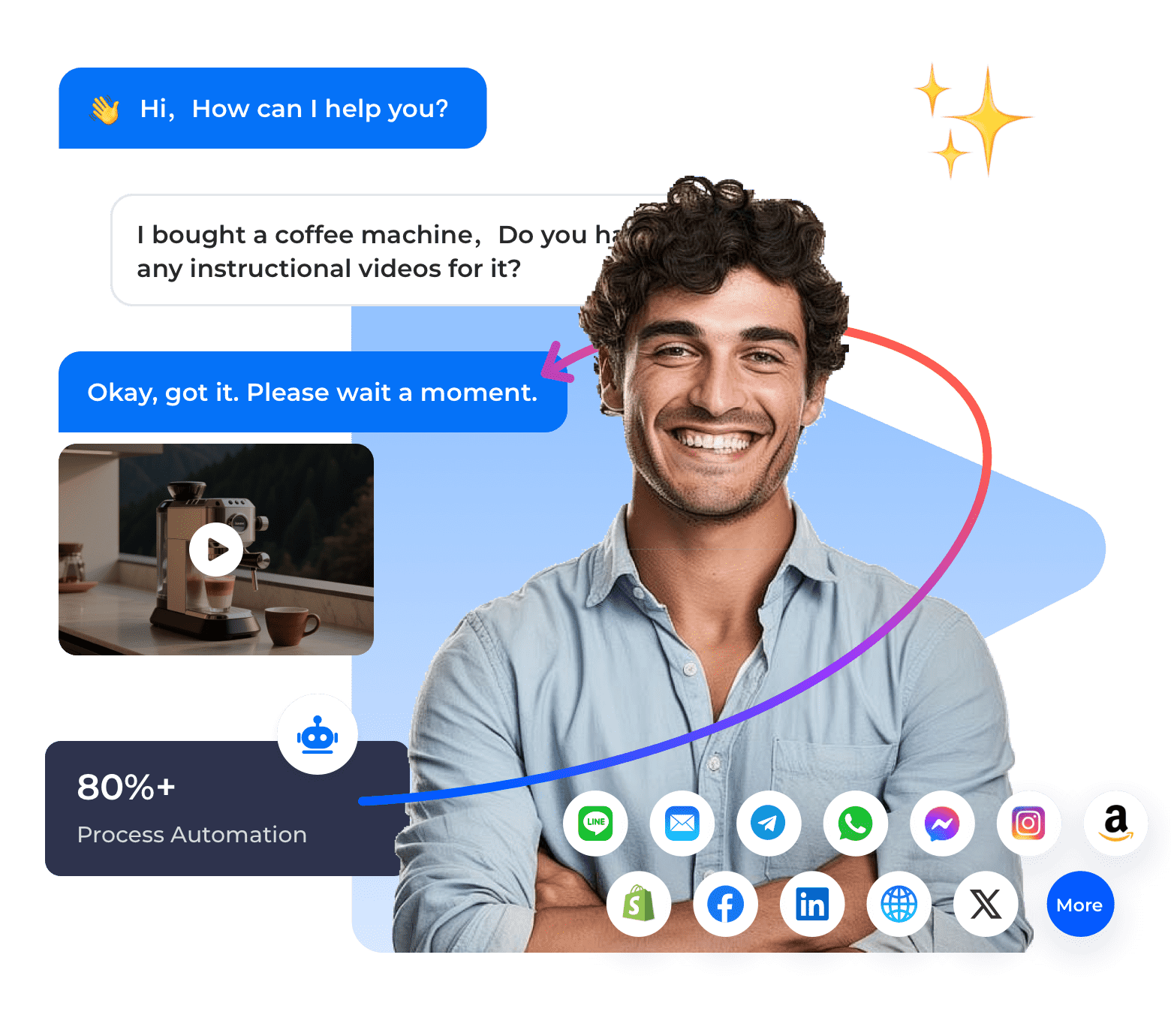
Your customers reach out across WhatsApp, Facebook, Instagram, email, chat, and voice. AI automation works across all of them, with real-time translation across 100+ languages serving customers in their preferred language—not just English.
What 80% Automation Actually Looks Like
A customer sends a WhatsApp message: "I need to return this shirt, it doesn't fit." They attach a photo of the receipt.
The AI reads the message, extracts the order number from the photo, checks your ERP to validate the purchase, s it's within the return window, and initiates the return process. It generates a return label, emails it to the customer, and updates the CRM. The entire interaction takes seconds. No human agent touched it.
The customer gets instant resolution. Your team stays focused on the complex cases that actually need human judgment.
How to Start Automating
Start with one high-volume scenario. Look at your ticket data. Which question appears most frequently? Order status? Returns? Focus there.
Use pre-built templates. Instadesk offer templates pre-trained on 40+ industries—e-commerce, manufacturing, finance, education. These accelerate deployment from months to days.
Connect your systems. The AI needs access to your CRM, ERP, and knowledge base to act, not just talk. Ensure seamless integration.
Measure, then expand. Track automation rate, resolution time, and customer satisfaction. When one scenario runs smoothly, expand to the next.
From Repetitive Questions to Strategic Focus
The real cost of repetitive questions isn't just agent time. It's the opportunity cost. Every minute spent answering "where's my order?" is a minute not spent on a complex issue that could determine whether a customer stays or leaves.
AI automation doesn't replace your team. It frees them to focus on what truly matters—building relationships, solving complex problems, and delivering service that turns customers into advocates. The questions are repetitive. The answers don't have to be.

Issac
Omnichannel Digital Operations: Driving Traffic Growth & Deepening User Value
You may also like

What is Upselling and Cross selling in AI-driven Customer Engagement
Companies usually use up-up sales and cross-sales to recommend something more expensive and advanced, or recommend some supporting services when chatting. The current service environment basically relies on artificial intelligence, and many automated dialogue programs have also begun to do these jobs.

What Is an AI-Powered Chatbot and How Telecom Operators Can Use It
An AI-powered chatbot is a software application that uses artificial intelligence—including natural language processing(NLP),machine learning,and sometimes generative AI—to simulate human-like conversations with users.Unlike traditional rule-based chatbots that follow rigid decision trees,AI-powered chatbots understand context,interpret user intent,learn from interactions,and generate dynamic,appropriate responses in real time.

What Is Artificial Intelligence Chat and How Manufacturers Can Use It
Artificial intelligence chat refers to technology that enables computers to simulate natural,human-like conversations with users through text or voice.Unlike simple rule-based chatbots that follow rigid scripts,artificial intelligence chat leverages natural language processing(NLP),machine learning,and generative AI to understand context,remember past interactions,and generate appropriate responses in real time.
Get Started in Minutes. Experience the Difference.