2026’s Top 8 AI Outbound Calling Platforms Replacing Traditional Call Centers
By 2026, the global intelligent outbound calling market will exceed $15 billion, with 85% of businesses adopting AI-powered voice technology . Yet many organizations still run the same playbook: hire agents, put them in cubicles, hand them lists of numbers, and hope they dial fast enough to hit quotas.
The math never worked well—high turnover, low conversion, and customers who learned to ignore unknown numbers. This guide evaluates eight alternatives to traditional outbound call centers, organized by what they actually deliver for modern sales teams.

What’s Wrong with Traditional Outbound Call Centers
The old model has three structural problems that no amount of management can fix:
Cost structure. A 10-agent team costs over $500,000 annually when you factor salaries, benefits, training, turnover, and facilities.
Capacity ceiling. Human agents make 50–80 calls per day, with only 15–20 minutes of actual conversation time. The average cold call success rate is just 2.7% .
Consistency gap. Performance varies wildly by agent. A great closer might convert 8–10% of calls; an average agent struggles at 2–3%.
The alternatives below solve one or more of these problems—and some solve all three.
Why AI-Native Platforms Are Winning in 2026
The platforms in this guide fall into two categories. AI-native platforms like Instadesk, Retell, and Air.ai were built from the ground up with AI at the core. Legacy-plus-AI platforms like Five9, Talkdesk, and Genesys added AI capabilities to existing contact center infrastructure.
Industry analysts note that AI-native platforms consistently deliver faster deployment (days vs. months), lower total cost of ownership, and higher autonomous resolution rates. For businesses prioritizing efficiency and ROI, AI-native architecture is no longer optional—it’s the baseline.
The eight platforms below represent the best in each category, with AI-native options leading in innovation and speed to value.
Category 1: AI-Native Outbound Platforms
1. Instadesk VoiceBot
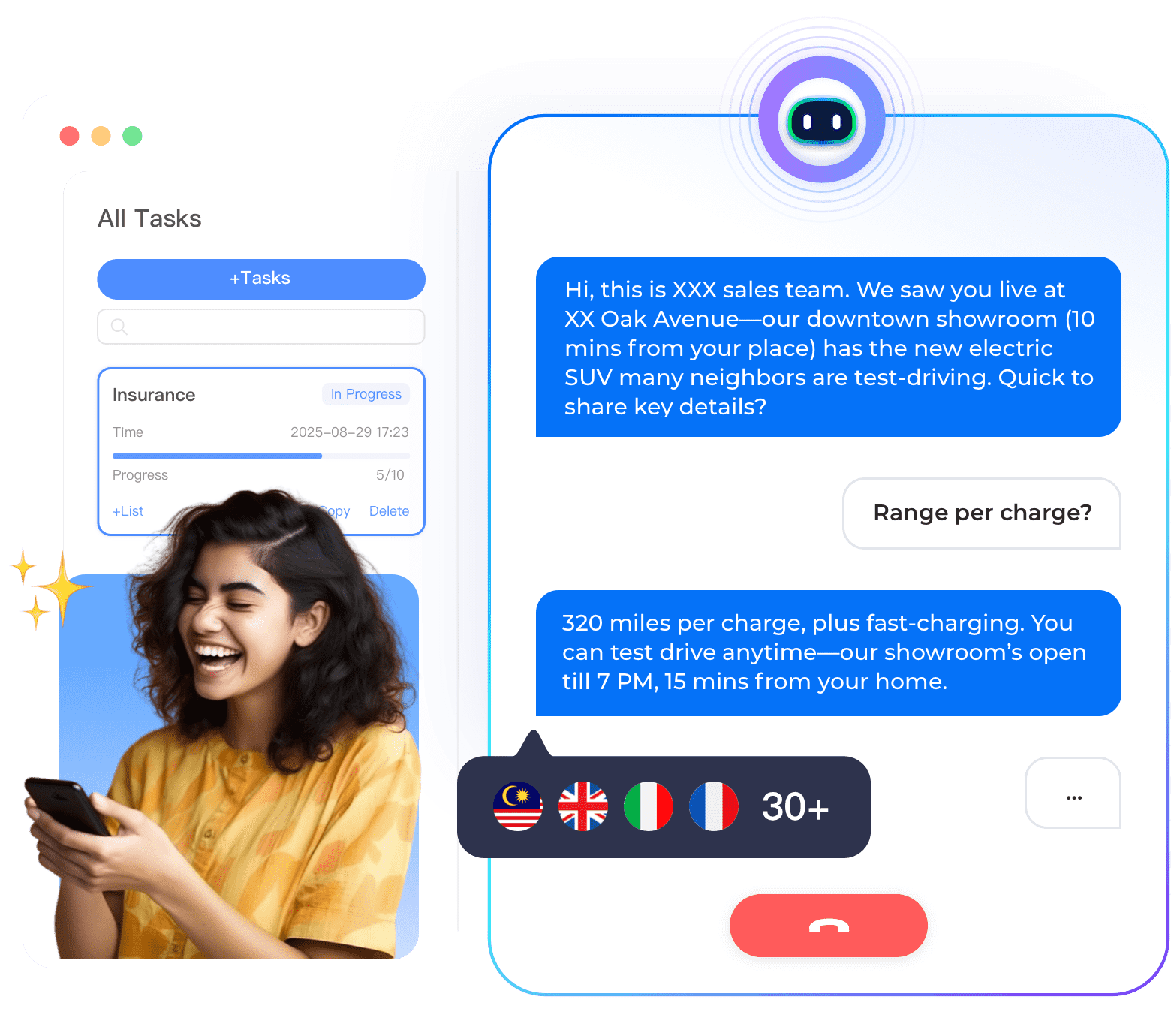
Instadesk VoiceBot combines large language model intelligence with zero-code orchestration for multilingual, high-volume outbound campaigns. A single AI voice agent handles the workload of 10 human representatives, operating 24/7 without breaks.
Key strengths: 30+ languages with code-switching (e.g., Malay/English), full-duplex conversation with <2-second interruption, emotion-infused voice that increases call duration, and deep CRM integration. Pre-built industry templates across 40+ industries reduce deployment to days.
Real-world performance: In one marketing campaign, Instadesk VoiceBot reached 500,000 members in two days—13× faster than manual efforts—with connection rates 125% above industry average and conversion rates up to 40% higher .
Best for: Global enterprises, financial services, and e-commerce brands that need high-volume, multilingual campaigns with measurable ROI and deployment in days, not months.
2. Retell AI
Retell AI focuses on low-latency, natural conversation for enterprise outbound calling. Its platform serves clients including Anker and Asbury Auto, processing over 40 million calls monthly with annual recurring revenue exceeding $40 million .
Key strengths: 50+ language support, sub-600ms latency, robust API for custom integrations.
Best for: Tech-forward companies with dedicated in-house AI engineering teams building custom voice applications.
3. Air.ai
Air.ai provides AI voice agents with “human-in-the-loop” control for quality assurance, supporting real-time call monitoring and manual takeover during live conversations.
Key strengths: Integrates with 5,000+ tools, transparent pricing ($0.11/minute outbound, $0.32/minute inbound) . Initial setup ranges from $25,000 to $100,000 depending on complexity .
Best for: Teams requiring strict human supervision and compliance oversight, particularly in regulated industries where AI autonomy is restricted.
Category 2: Integrated Contact Center Platforms
4. Five9
Five9 integrates AI-powered outbound dialing through its partnership with Google Cloud , combining contact center infrastructure with Google’s AI tools for predictive dialing and blended campaigns.
Key strengths: Proven reliability at scale, deep workforce management tools, strong compliance features.
Best for: Large enterprises already using Five9 for inbound that want to consolidate outbound on the same platform.
5. Talkdesk
Talkdesk offers AI-powered outbound capabilities through Talkdesk AI Agent and predictive dialer, with low-code customization for tailored workflows.
Key strengths: Shopify integrations, real-time analytics, customizable dashboards.
Best for: E-commerce and retail brands with high-volume, seasonal outbound needs.
6. Genesys Cloud
Genesys Cloud provides omnichannel outbound capabilities as part of its broader platform, with AI features including automated topic generation and predictive routing .
Key strengths: Global carrier network, workforce engagement tools, robust compliance.
Best for: Large enterprises with established call center infrastructure and complex routing needs.
Category 3: Specialized Tools
7. Gorgias
Gorgias is built for e-commerce support, with outbound features like automated post-purchase follow-ups and review requests. Plans start at $10 per month .
Key strengths: Deep Shopify integration, order management within chat interface, automated returns processing.
Best for: E-commerce DTC brands with high order volumes where order management is the primary support function.
8. Outreach.io
Outreach.io combines sales engagement sequences with AI-powered calling. Its Personalization Agent integrates with Google’s Chirp3-HD voice model and supports 15+ languages .
Key strengths: Multi-channel sequencing, sales analytics, CRM integration (Salesforce, HubSpot).
Best for: B2B sales teams running complex, multi-touch campaigns that combine phone with email and LinkedIn.
How to Choose the Right Alternative
• Before you compare features, ask these three questions. The answers will tell you which platform category fits your needs:
• Do you serve multilingual customers? If yes, prioritize platforms with 30+ languages and code-switching capability (handling mixed languages like English and Malay in one conversation). Among the platforms above, Instadesk VoiceBot is the only one that offers this out of the box.
• Do you need natural, interruptible conversation? If yes, look for full-duplex with <2-second interruption response—non-negotiable for calls that feel human.
• How fast do you need to deploy? If weeks, choose AI-native. If months are acceptable, legacy platforms work.
| Category | Best For | Trade-Off |
| AI-Native (Instadesk, Retell, Air.ai) | Speed, innovation, multilingual capability | Air.ai requires upfront implementation investment |
| Integrated (Five9, Talkdesk, Genesys) | Enterprises with existing CCaaS infrastructure | Months-long deployment; higher TCO |
| Specialized (Gorgias, Outreach) | Vertical-specific workflows | Narrow focus; not general-purpose |
What to Look For in 2026
Traditional outbound call centers aren’t obsolete. But they’re no longer the default choice. The alternatives above offer something the old model never could: scale without headcount, consistency without micromanagement, and conversation quality that matches human agents.
For most businesses in 2026, the answer isn’t a single platform. It’s a strategy that matches the right tool to the right use case. Ready to see how AI outbound performs for your business? Start with a free trial or request a demo to test the difference.
Share This Article


Chris
Senior Customer Service Operations Analyst
You may also like

What is Outbound Call Robot for Scalable Global Customer Engagement
The outcall robot is no longer just an automatic dialing machine. It has become the infrastructure at the bottom of global customer interaction. There are many languages in Southeast Asia. The time zones of different countries are very complicated. Artificial intelligence voice interaction with smart workflow. Enterprises add compliance means.


From Transactions to Trust: How AI VoiceBot is Transforming CX in Financial Services
In financial services, a phone call represents more than a transaction. It is a critical moment to build trust and security. Yet traditional call centers struggle with long wait times and inconsistent service. Instadesk AI voicebot changes this dynamic for modern financial institutions.


What Is Market Research?A Guide for Telecom Operators
Market research is the systematic process of gathering,analyzing,and interpreting information about a market,including customer needs,competitor strategies,and industry trends.For telecommunications operators navigating rapidly evolving technologies,shifting consumer behaviors,and intense competition,effective market research is essential for making informed decisions about service offerings,pricing,and customer experience investments.This article defines market research,explains how it differs from business intelligence,outlines its importance for telecom operators,provides a practical implementation guide,and demonstrates how Instadesk’s VoiceBot can enhance market research capabilities through automated customer insights.
Get Started in Minutes. Experience the Difference.