
Core Functions of an AI Ticket System: How Intelligent Ticketing Enables Scalable Global Customer Support
For enterprises serving overseas markets, customer support is no longer a task for a single channel or region, but rather a complex system that operates in parallel across multiple channels, regions, and time zones. Customer inquiries come from various platforms and are made in different languages, yet their expectations for response speed and service consistency are getting higher and higher.

As business scale expands and service scenarios become more complex, traditional work order systems gradually show their inability to handle a large number of cross-regional inquiries. Reliance on manual allocation, rigid rules, and limited automation can all affect service efficiency and customer experience.
The AI work order system, by introducing intelligent analysis and automation capabilities, helps enterprises manage customer requests more efficiently in a complex international service environment and achieve large-scale and stable customer support.
I. Challenges Faced by Traditional work Order Systems in large-scale Scenarios
Traditional work order systems were initially mainly used in single-channel or localized service scenarios. When customer service expands to multiple countries and regions, its limitations begin to emerge.
Firstly, the creation and allocation of work orders are highly dependent on manual operations. As the volume of inquiries increases, customer service staff need to spend a considerable amount of time organizing and assigning work orders rather than solving customer problems. Secondly, the lack of intelligent priority judgment makes it difficult to identify urgent or high-risk issues in a timely manner. Furthermore, it is difficult for the management to grasp the overall service status in real time, which may lead to response delays or fluctuations in service quality.
These issues will be continuously magnified in cross-regional operations, directly affecting customer satisfaction and operational efficiency.
II. What is an AI work order system
The AI work order system is a customer service solution that deeply integrates artificial intelligence technology on the basis of traditional work order management.
It is not only used to record customer requests, but also can automatically analyze customer intentions, classify problem types, assist in diversion decisions, and continuously optimize service processes. In the system, AI plays the role of "intelligent collaboration" rather than a simple recording tool.
Through automation and data analysis capabilities, the AI work order system can help enterprises maintain a clear, orderly and efficient operational state even when their service scale expands.
III. Core Function One: Intelligent Work Order Classification and Diversion
Intelligent classification is one of the most core capabilities of the AI work order system.
The system analyzes the content of customer messages through natural language processing technology, automatically identifies the issue topic, urgency and potential emotions, and assigns work orders to the most suitable team or customer service staff. The diversion rules can not only be configured based on the type of problem, but also in combination with language, region or time zone.
This mechanism significantly reduces the cost of manual allocation, shortens the response time, and simultaneously enhances the accuracy of problem-solving.
IV. Core Function Two: Unified management of multi-channel work orders
In overseas customer service scenarios, inquiries often come from multiple channels.
The AI work order system can uniformly convert messages from sources such as emails, online chats, social platforms, and website forms into work orders and manage them centrally on one platform. Customer service staff can view the complete communication history on the same interface, avoiding scattered information and repetitive communication.
This multi-channel integration capability ensures that customers can obtain a consistent service experience no matter which platform they contact the enterprise through.
V. Core Function Three: AI-assisted Response and process Automation
The AI work order system further enhances customer service efficiency by assisting in responses and automating processes.
The system can recommend appropriate response content based on historical data and knowledge bases to handle high-frequency and standardized issues. Meanwhile, processes such as work order upgrades, status updates, and reminder follow-ups can be automatically executed, reducing manual operations.
This enables customer service staff to focus their energy on more complex and valuable customer needs.
VI. Core Function Four: Priority Management and SLA Support
In a cross-regional service environment, reasonable priority management is particularly crucial.
The AI work order system can dynamically determine the urgency of work orders by integrating factors such as keywords, sentiment analysis, and customer historical behavior. Potential complaints, compliance risks or high-value customer requests will be automatically identified and prioritized for processing.
This mechanism helps enterprises better meet SLA requirements and rationally allocate service resources.
VII. Core Function Five: Data Analysis and Service Insights
In addition to handling daily work orders, the AI work order system can also provide data support for management decisions.
The system helps enterprises identify service bottlenecks and optimization Spaces by analyzing the duration of resolution, backlog of work orders, repetitive issues, and trends in customer satisfaction. These data provide reliable basis for process improvement and resource allocation.
VIII. Practical Reference for the Instadesk Ticket System
The Instadesk Ticket System applies AI capabilities to multi-channel and multi-regional customer service scenarios.
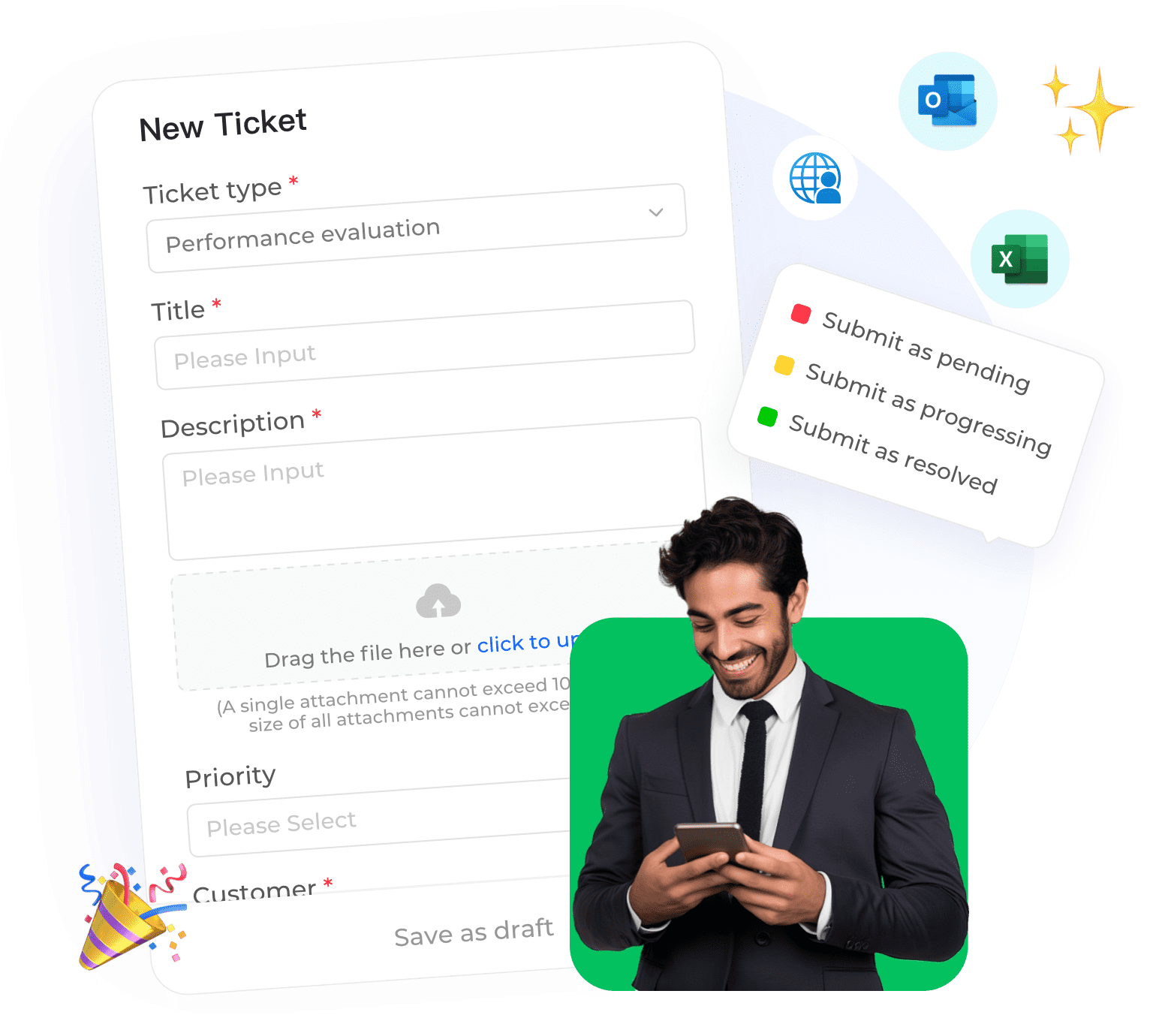
Within the Instadesk system, customer inquiries generated from various channels are uniformly managed. Through intelligent classification, automatic diversion, and process collaboration, it helps enterprises efficiently respond to the continuously growing service demands.
This system is not an independent tool but rather a part of the overall customer service system, supporting end-to-end service management.
IX. The value brought to the customer service team and the enterprise
For customer service staff, the AI work order system can reduce repetitive operations, clarify processing priorities, and provide complete customer background information.
For managers, the system brings greater service transparency and risk controllability.
For the enterprise as a whole, it builds a sustainable and scalable customer support foundation.
Conclusion
As customer service goes global and multi-channel, AI work order systems are becoming an important infrastructure for enterprises to enhance their service capabilities.
Through intelligent diversion, automated processing and data-driven optimization, the AI work order system helps enterprises expand their service scale while continuously maintaining a stable and high-quality customer experience.
For enterprises targeting overseas markets, introducing an AI work order system is not only a technological upgrade but also a crucial step to support long-term business development.

Issac
Omnichannel Digital Operations: Driving Traffic Growth & Deepening User Value
You may also like

Customer Service Ticket Systems: Enabling Scalable and Structured Global Support
Today, when globalization and multi-channel services have become the norm, Customer Service Ticket has become the basic capability of the enterprise customer support system.

Network Solutions for Customer Service: How a Ticket System Enables Scalable Support Instadesk Ticket System as a Practical Example
As businesses expand across regions and digital channels, customer service has become a core part of modern network operations. Customers expect fast responses, consistent experiences, and clear issue resolution—no matter which channel they use.

How Much Does a Customer Service Ticketing System Cost? How Can Enterprises Choose the Right Solution and Avoid Common Pitfalls?
When enterprises choose a customer service ticketing system, price is always an unavoidable topic. Especially when the prices of products on the market range from several thousand to several hundred thousand and the functional descriptions are dazzling, many enterprises will find themselves in a dilemma of "choosing an expensive one for fear of waste and choosing a cheap one for fear of falling into a trap". Today, I will combine the solution of Instadesk AI to talk about how much the customer service ticketing system actually costs. How can enterprises choose the right solution and avoid common pitfalls? Help business practitioners clear their way!
Get Started in Minutes. Experience the Difference.