Omnichannel Customer Support on Messaging Apps: Managing WhatsApp, LINE, Telegram, and Beyond
Messaging apps have evolved far beyond simple communication tools—they are now a primary channel for customer support. Every day, millions of customers reach out to brands on WhatsApp, LINE, Telegram, and other platforms, expecting quick answers and seamless service. But for many businesses, managing support across multiple messaging apps remains fragmented and inconsistent.
The scale is immense. WhatsApp serves over 3 billion monthly active users, making it one of the largest communication platforms worldwide. Telegram has surpassed 800 million monthly active users, with strong adoption in Europe, the Middle East, and Southeast Asia. LINE commands over 200 million monthly active users across Japan, Taiwan, Thailand, and Indonesia. When customers are already spending hours on these platforms, they expect to reach businesses there too.
Yet the reality often falls short. Customers find themselves repeating issues as they switch between apps, waiting hours for responses, or being bounced between disconnected teams. For businesses, this fragmentation creates inefficiency, missed opportunities, and frustrated customers who may take their business elsewhere.
This article explores how businesses can manage customer support across WhatsApp, LINE, Telegram, and other messaging channels through an omnichannel approach, the key challenges involved, and how solutions like Instadesk enable organizations to unify conversations, improve response efficiency, and deliver seamless customer experiences at scale.

What Is Omnichannel Customer Support in a Messaging Context?
Omnichannel customer support in the messaging context means integrating all conversation channels—WhatsApp, LINE, Telegram, Facebook Messenger, and others—into a single, seamless experience where customers can switch between platforms without losing context or repeating information.
The distinction from multichannel is critical. Multichannel means being present on multiple channels, but each operates in isolation. A customer who starts a conversation on WhatsApp, then follows up on Telegram, will likely have to start over—the agent sees two disconnected conversations. Omnichannel means those channels are connected. The customer history, preferences, and unresolved issues travel with them, regardless of which app they use.
The business impact is measurable. Companies with robust omnichannel customer engagement retain an average of 89% of their customers, compared to just 33% for those with fragmented strategies. When channels are disconnected, customers notice. More than half (56%) of consumers say their favorite brand delivers seamless, connected experiences across channels, while 82% are put off by disorganized interactions that require them to repeat information. The expectation is clear: customers want service that moves with them, not against them.
Why WhatsApp, LINE, and Telegram Are Critical Customer Support Channels
1. WhatsApp: Global Scale with Unmatched Reach
With over 3 billion monthly active users worldwide, WhatsApp is the largest messaging platform in the world. Its 98% message open rate far exceeds email’s 20% average, making it one of the most effective channels for customer communication. WhatsApp Business has become the primary infrastructure for global commerce, enabling businesses to engage customers in real time with order updates, shipping notifications, support inquiries, and service s.
2. LINE: Regional Dominance in Asia
LINE commands over 200 million monthly active users across Japan, Taiwan, Thailand, and Indonesia. In Japan alone, LINE has over 100 million monthly active users, representing 81% of the population. The platform functions as a central lifestyle ecosystem where users communicate, pay bills, shop, and access services. For businesses operating in these markets, LINE is a non-negotiable customer support channel.
3. Telegram: Fast-Growing Platform for Privacy-Conscious Users
Telegram has surpassed 800 million monthly active users, with particularly strong adoption in Europe, the Middle East, and Southeast Asia. Its focus on privacy, speed, and bot-friendly APIs has made it a popular choice for businesses seeking automated customer interactions. Telegram’s open platform allows for advanced bot integrations, making it an increasingly important channel for customer support and engagement.
Key Challenges in Managing Messaging Support Without Omnichannel
• Fragmented conversations across multiple platforms. Customers often reach out through different channels for the same issue. Without an omnichannel system, each conversation lives in a separate silo. The result is repeated information, lost context, and frustrated customers.
• High expectations for fast responses. Messaging apps operate in real time. Customers expect near-instant replies, yet many businesses struggle to keep up across multiple platforms. According to industry data, only 43% of companies have expanded beyond email and SMS, and just 11% report full integration between messaging platforms and CRM or business systems. The gap between ambition and execution is wide.
• Rising volume of customer inquiries. As customers increasingly turn to messaging for support, businesses face growing volumes of questions, complaints, and service requests. Without automation and unified workflows, teams become overwhelmed.
• Inability to take action without system integration. A chatbot that answers questions is helpful. A chatbot that can check order status, process returns, or update customer records is transformative. Without deep integration with CRM and ERP systems, messaging support remains superficial—able to respond but not to resolve.
Benefits of Omnichannel Messaging Support
• Improved customer satisfaction. When customers can switch between WhatsApp, LINE, and Telegram without repeating themselves, frustration drops and satisfaction rises. Unified conversations show customers they are valued, not just processed.Faster response and resolution times. Centralizing conversations from multiple messaging apps into a single dashboard allows agents to respond more quickly without switching between platforms. Automation handles routine inquiries instantly.
• Increased agent productivity. Unified systems reduce manual work. AI-powered tools can handle up to 80% of routine customer inquiries, freeing agents to focus on complex issues that require human judgment and empathy.
• Enhanced brand reputation. Consistent, timely responses across messaging channels build trust. Customers who receive good service are more likely to purchase again—88% say good customer service makes them more likely to return.
• Revenue growth. Better service experiences drive higher spending. Customers who receive excellent service can spend up to 140% more than those with poor experiences. Omnichannel platforms capture inquiries from messaging apps in real time, reducing missed sales opportunities and improving conversion rates.
How Platforms Like Instadesk Enable Omnichannel Messaging Support
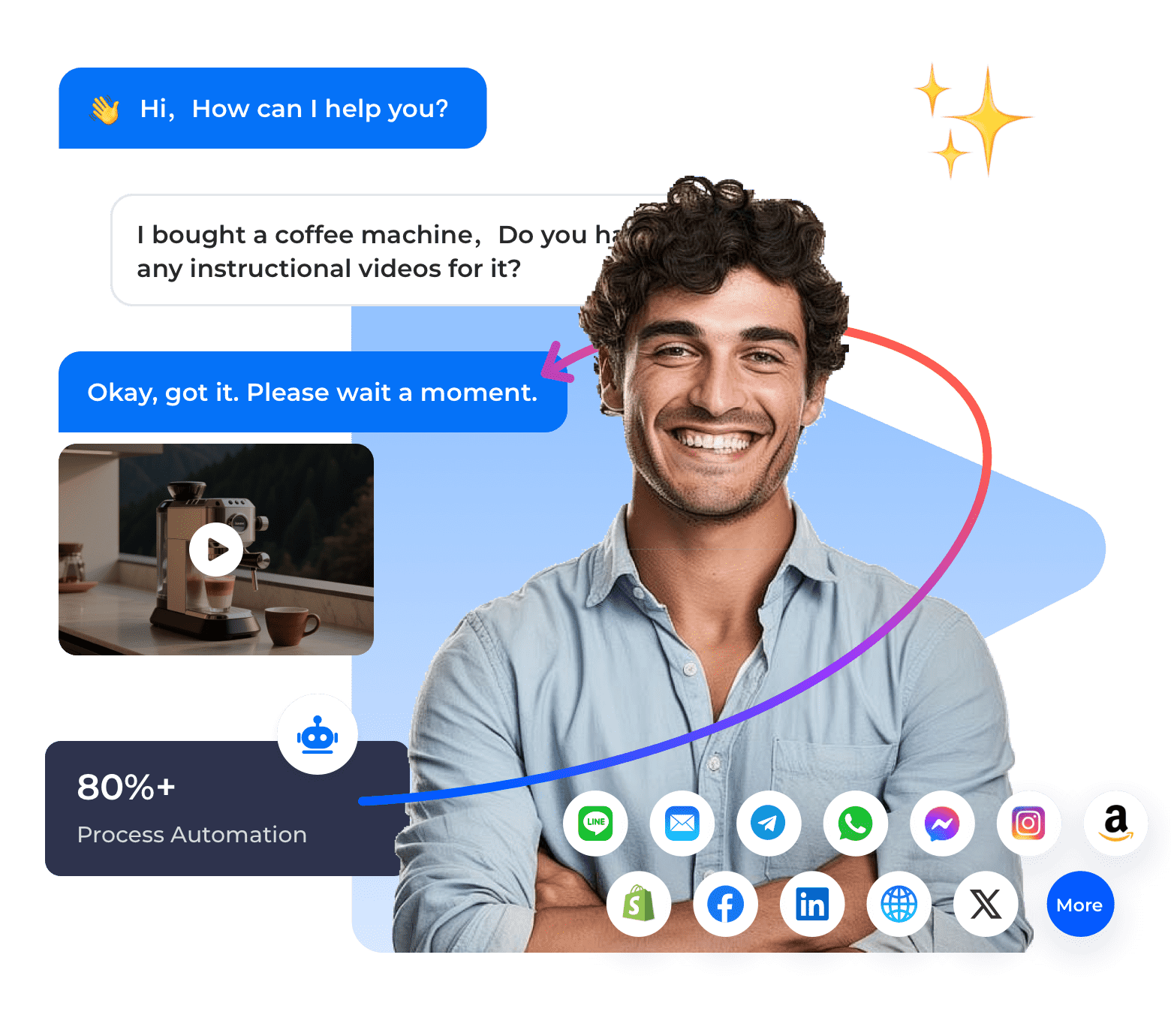
• Centralized omnichannel inbox. Instadesk provides a unified dashboard where support teams can manage conversations from WhatsApp, LINE, Telegram, and other channels in one place. No more switching between apps or missing messages across platforms.
• 100+ language real-time translation. Instadesk deeply integrates cross-cultural communication, providing real-time text translation across 20+ major overseas channels and over 100 languages. Businesses can serve global customers in their native language without maintaining multilingual teams.
• Deep system integration. Instadesk seamlessly integrates with business systems such as CRM and ERP, automating over 80% of processes such as returns, exchanges, and logistics inquiries. When a customer asks “Where’s my order?” the AI checks the actual tracking status in the ERP and responds with real-time information—not a canned reply.
• Multimodal interaction. Customers send screenshots, photos of damaged products, scans of receipts. Instadesk’s multimodal AI processes text and images together, extracting information from visual inputs without forcing customers to describe what they could simply show.
• Zero-code visual orchestration. Business teams can build and iterate AI agents without engineering support. Drag-and-drop interfaces and pre-built templates across 40+ industries accelerate deployment from months to days.
• Continuous learning with robot operations. Once deployed, the agent doesn’t sit still. Robot operations automatically flag when training materials need updates, perform online knowledge disambiguation, and surface performance gaps. The system improves with every conversation.
Wrap Up
Messaging apps like WhatsApp, LINE, and Telegram are now frontline customer support channels, but managing them separately creates fragmented conversations, slower response times, and inconsistent service. The gap between ambition and execution is wide: 99% of companies say omnichannel communication is strategically important, yet only 43% have moved beyond email and SMS.
Adopting an omnichannel approach—unified inbox, AI automation, and deep system integration—helps businesses scale support while meeting rising customer expectations. Solutions like Instadesk enable organizations to centralize messaging support, automate routine interactions, and turn scattered channels into a seamless customer experience.
Share This Article


Chris
Senior Customer Service Operations Analyst
You may also like

What Is a Customer Service Automation Platform?A Guide for Telecom Operators
A customer service automation platform is a software solution that uses artificial intelligence,chatbots,voicebots,and workflow automation to handle customer interactions without human involvement.For telecom operators managing millions of billing inquiries,technical support requests,and outage reports,such a platform automates routine tasks,provides instant responses,and escalates complex issues to human agents.This article defines customer service automation platforms,explains how they differ from traditional help desk software,highlights their importance for telecom,provides a usage guide,demonstrates how AI tools enhance efficiency,answers common questions,and concludes with key takeaways.


AI-Powered FAQ Bot for Logistics Tracking Inquiries
AI-powered FAQ bots automate logistics tracking inquiries by understanding natural language, retrieving real-time TMS data, and providing instant answers. This article covers their benefits, how they differ from static FAQs, and how Instadesk’s Chatbot platform delivers efficient, personalized tracking responses.

Chatbot That Integrates with ERP and CRM Systems:A Guide for Fintech Companies
Fintech companies rely on accurate,real-time customer data to answer inquiries about accounts,transactions,loans,and investments.A chatbot integrated with your ERP(enterprise resource planning)and CRM(customer relationship management)systems can access this data instantly,delivering personalized,context-aware responses.Unlike standalone chatbots that lack visibility into customer history,integrated chatbots retrieve account balances,loan statuses,transaction history,and payment due dates—all within the natural flow of conversation.T
Get Started in Minutes. Experience the Difference.