AI Outbound Calling: How to Automate Sales Calls and Increase Conversion by 40%
Sales teams face a fundamental constraint: time. Manual dialing, voicemail navigation, and data entry consume hours that could be spent on actual selling. Even with efficient processes, a single sales representative can only handle a limited number of meaningful conversations each day.
AI outbound calling changes this equation. Instead of teams limited by human bandwidth, businesses can scale conversations without scaling headcount. Organizations implementing AI outbound calling see conversion rates increase by 40%, sales efficiency improve by 10x, and customer satisfaction jump by 65%.

Limits of Manual Outbound Calling
Traditional outbound calling is labor-intensive by design. Each call requires manual dialing, waiting through rings, leaving voicemails, and updating records. The time spent on these activities adds up quickly, leaving little room for actual conversation.
Beyond productivity limits, manual calling faces consistency challenges. A great salesperson might close deals consistently; an average one might struggle. Performance depends on mood, energy, and experience level. Training new hires takes weeks or months, and turnover remains high.
The result is a system that's expensive to scale and hard to predict. Adding headcount increases costs linearly without guaranteeing results.
How AI Outbound Calling Transforms Sales Outreach
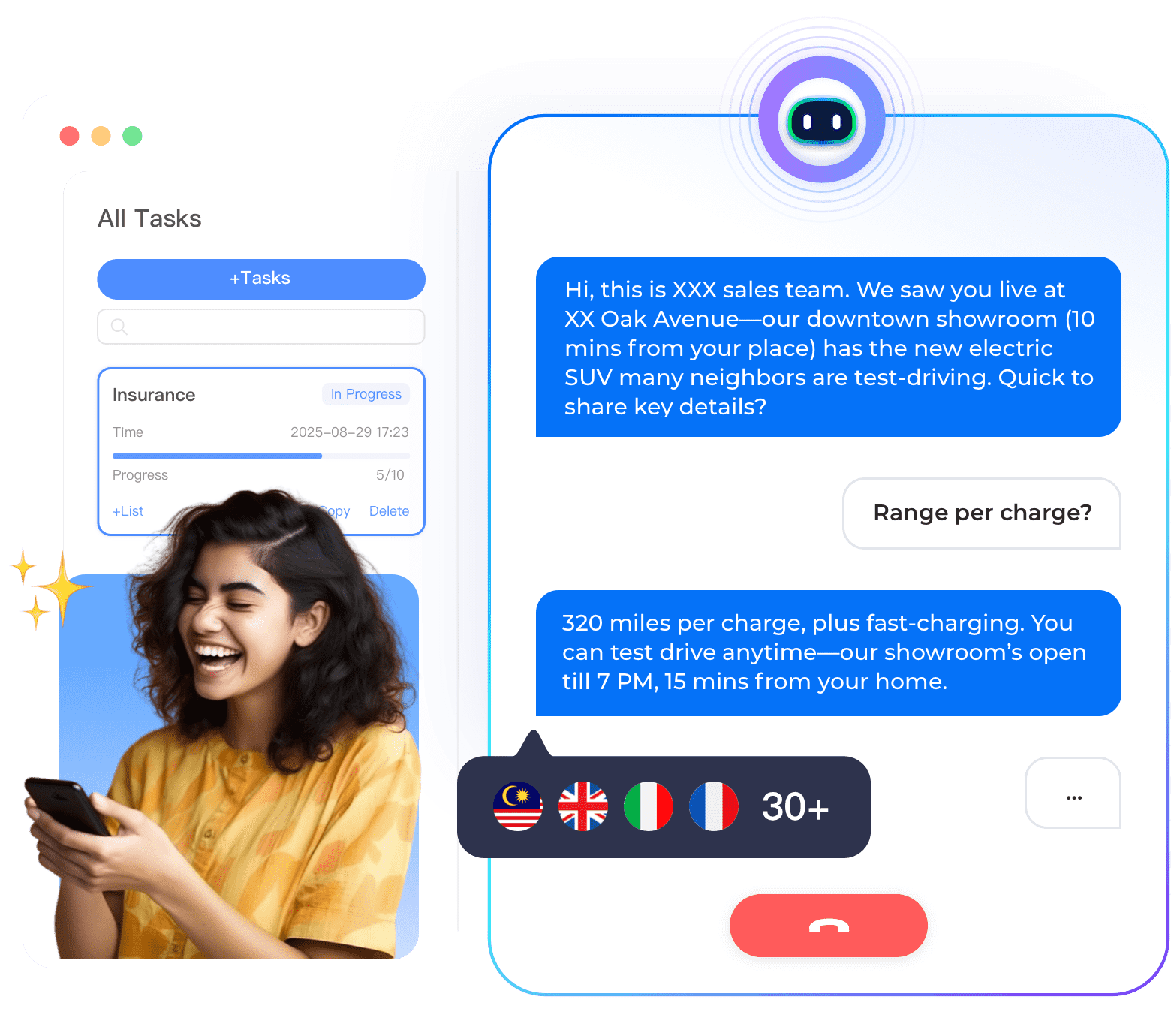
AI outbound calling represents a fundamental shift from manual dialing to intelligent conversation. These systems don't just place calls—they engage naturally, understand context, and adapt in real time.
1. Scale without headcount. A single AI voice agent handles the workload of 10 human representatives, operating 24/7 without breaks—increasing outbound call efficiency by up to 1,000%.
2. Natural, human-like conversation. Leading AI voicebots support full-duplex conversation, listening and speaking simultaneously. When a customer interrupts, the AI stops, processes the new input, and adjusts its response—all in under 2 seconds. The system can mimic uploaded voice recordings, infusing responses with emotion that keeps customers engaged longer.
3. Personalization through CRM integration. By connecting with CRM data, AI voicebots reference past interactions and customer preferences during conversations, adjusting tone and messaging based on emotional state. Call outcomes sync back automatically, creating a closed-loop system.
4. Multilingual capability. Supporting 30+ languages with native understanding, AI outbound calling handles code-switching (like English and Malay mixed mid-conversation) and adapts to local communication habits. This capability has helped financial and technology clients increase conversion rates by over 30% in marketing and invitation scenarios.
Real-World Results: 40% Higher Conversion
Consider a real-world campaign. A leading audio content platform needed to reach over 500,000 members with a marketing invitation. Traditional on-site reminders and manual outbound calls had low reach rates, low conversion rates, and high costs.
With AI outbound calling, the entire campaign was completed in just two days. The system intelligently reached 500,000+ members with high-concurrency, stable performance. Predictive outbound calling and automatic redialing further optimized reach.
The results: outbound connection rates reached 125% of industry average. Outbound efficiency was 13 times higher than manual efforts. The campaign achieved 100% coverage of members through outbound notifications.
Beyond marketing, AI outbound calling delivers similar results across lead qualification (50% faster lead processing), payment reminders (recovering forgotten payments without damaging relationships), and appointment ations (reducing no-shows).
How to Start Automating Outbound Calls
Step 1: Choose your first use case. Start with one high-volume, structured workflow—marketing invitations, lead qualification, appointment reminders, or payment reminders.
Step 2: Set up your campaign. Use pre-built industry templates to accelerate deployment. Platforms with experience across 40+ industries—manufacturing, e-commerce, finance, education—offer conversation templates validated through real outbound performance. Zero-code visual orchestration lets business teams configure call flows without engineering support.
Step 3: Integrate with your CRM. Seamless CRM integration enables personalization and outcome tracking. Call outcomes—lead scores, qualification status, follow-up needs—sync back automatically, creating a closed-loop system.
Step 4: Test, measure, optimize. Run a pilot with a controlled segment. Track key metrics: connect rate, conversion rate, average handle time. Use conversation analytics to identify winning scripts and objection-handling patterns. Iterate based on real results.
Platforms like Instadesk VoiceBot provide real-time analytics dashboards with automated tagging, conversation summaries, and CRM synchronization, enabling continuous campaign optimization.
ROI Is Clear
The economics of AI outbound calling are clear. Ten times the efficiency. Forty percent higher conversion. Thirteen times faster than manual efforts. Ninety percent faster sales follow-up. And most importantly, human teams freed from repetitive dialing to focus on building relationships and closing deals.
The technology is ready. The ROI is proven. For businesses looking to scale outbound sales without scaling headcount, AI outbound calling delivers results that manual processes simply cannot match.
Tags

Chris
Senior Customer Service Operations Analyst
You may also like

The Difference Between Voicebot and Chatbot:A Practical Guide for Southeast Asia Businesses
People are asking what is the difference between voice robots and chatbots. They want to figure out which way is more helpful to the customer's communication plan. This kind of market in Southeast Asia is developing rapidly. Users want to get a reply quickly in a localized way of communication. They hope that all channels will have the same service.


Driving Intelligent Governance: How Instadesk VoiceBot Empowers Government Public Services
Modern citizens expect government services to be fast, accurate, and available at any hour. Traditional public sector contact centers often struggle to meet these demands due to outdated systems and high call volumes. Intelligent automation offers a clear path forward, transforming how agencies interact with the people they serve.


How to Implement LLM-Powered Voice Bots in Global Logistics: A Practical Case Study Guide
This practical guide combines real case studies of Instadesk LLM-powered voice bots in global logistics, details implementation steps, risk avoidance methods, and effect verification strategies, helping logistics enterprises achieve smooth landing and cost reduction with AI voice bots.

Get Started in Minutes. Experience the Difference.