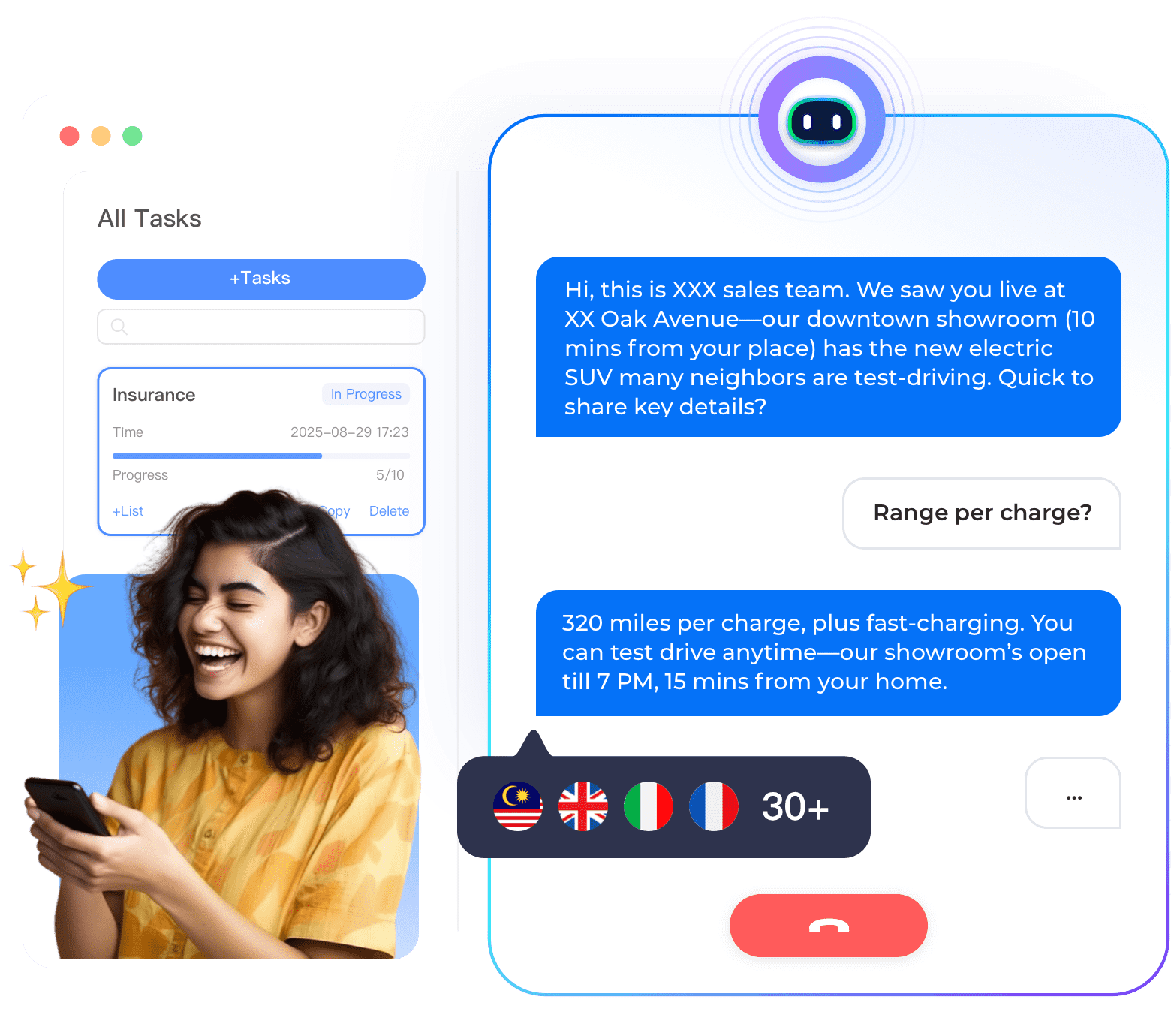
The global voice AI market is projected to reach $11.71 billion in 2026. As businesses expand across borders, customers expect 24/7 service in their native language—and they can tell when a voicebot is merely translating words versus truly understanding them.
Whether you're a European bank expanding into Latin America, an e-commerce platform serving the Middle East, or a healthcare provider with patients across Asia, choosing the right multilingual voicebot is critical. This guide provides four criteria to evaluate solutions in 2026.

Criterion 1: Native Multilingual Intelligence
The fundamental question: Does your voicebot think in multiple languages, or does it translate everything through an English pipeline?
What to evaluate:
• Language coverage: Does the platform offer generally available support for your target languages (e.g., Spanish, Arabic, Mandarin, Malay), or are they still in beta?
• Code-switching capability: Can it handle mixed-language conversations like "I need to check my order, pero no tengo el número" (English/Spanish) or "بيان الصوت، saya perlukan bantuan" (Arabic/Malay)? This is the "code-switching test" that separates native fluency from translation workarounds.
• ASR accuracy in noise: Request word error rate benchmarks on audio similar to your environment—contact centers typically operate at 10-15 dB signal-to-noise ratio.
Why it matters: A 2024 study found that 73% of consumers prefer to interact with brands in their native language, and 40% will not purchase from websites in other languages. In multilingual markets like Canada, Belgium, or Singapore, code-switching is the default communication style—solutions that can't handle mixed-language conversations will frustrate callers immediately.
Criterion 2: Agentic Architecture & Voicebot 2.0 Performance
In 2026, the focus has shifted from generative AI that talks to agentic AI that acts—systems that perceive, reason, act, and learn autonomously.
Critical performance metrics:
• End-to-end latency: ITU-T G.114 establishes 150ms one-way delay as optimal for high-quality real-time traffic; sub-300ms is the enterprise standard.
• Full-duplex with interruption handling: Can the bot be interrupted naturally? Response to interruption should be under 2 seconds to feel human-like.
• Multi-turn conversation depth: Does it maintain context across complex, branching dialogues?
• Concurrent call capacity: Can it handle your peak loads?
Why it matters: A 2025 study found that 53% of consumers will abandon a call if the voice agent fails to understand them within two tries. Latency over 2 seconds increases caller frustration by 300%. In competitive markets, every interaction counts—callers won't give a second chance to a bot that feels "off."
Criterion 3: Compliance, Security & Data Sovereignty
For global enterprises, this is often the dealbreaker. Voice data cannot be processed across borders without violating local regulations.
Essential requirements:
• Data residency controls: Can you define where voice data is processed and stored? (e.g., EU data must stay in EU for GDPR compliance)
• Compliance certifications: SOC 2 Type II, GDPR, HIPAA, and local regulations (e.g., Thailand's PDPA, Brazil's LGPD, Singapore's MAS guidelines).
• Encryption and PII redaction: Is sensitive data automatically masked during calls and in recordings?
• Deployment flexibility: Do they offer SaaS, dedicated single-tenant, and on-premise options for regulated industries?
Why it matters: In 2024, a major bank was fined $2.4 million for outsourcing failures that exposed customer data. For financial institutions globally, voicebot vendors must demonstrate clear data governance—not just promise it. GDPR fines can reach €20 million or 4% of global revenue, making data residency a board-level concern.
Criterion 4: Business Integration & Measurable ROI
A voicebot isn't an island. It must integrate with your CRM, telephony stack, and business workflows.
Integration checklist:
• CRM connectors: Does it integrate with Salesforce, HubSpot, Zoho, Microsoft Dynamics, or others via native connectors or APIs?
• Transaction capabilities: Can it trigger actions (bill pay, order status updates, appointment booking) or just answer questions?
• Analytics depth: Real-time dashboards for sentiment trends, fallback rates, and CSAT scores?
• Pricing transparency: Are there hidden LLM pass-through fees, or is pricing bundled at predictable rates?
2026 Platform Landscape: A Quick Overview
| Platform Category | Examples | Language Strengths | Best For |
| Global Generalists | Google Dialogflow CX, Amazon Lex | 100+ languages, broad coverage | Companies already deep in these cloud ecosystems |
| Enterprise Specialists | IBM Watson, Retell AI | Western European languages, low latency | Regulated industries requiring custom SLAs |
| India-Focused | Mihup, Yellow.ai | Indic languages (Hindi, Tamil, Telugu, etc.) | Indian market specialization |
| Multi-Region Platforms | Instadesk, Cognigy, Kore.ai | 30-50 languages with regional optimization | Global deployments requiring both breadth and depth |
The platform reality: Global platforms often claim support for dozens of languages—but "support" can mean basic translation-layer responses, not native understanding. Enterprise specialists excel in core markets but may lack depth in emerging regions. Multi-region platforms like Instadesk invest in both language breadth and regional optimization, offering capabilities like bilingual natural conversation recognition (e.g., Malay/English, Spanish/English, Arabic/English) adapted to local communication habits across multiple continents.
Your 2026 Buyer's Checklist
Language & Accuracy
• Native support for target languages tested with real local recordings
• Code-switching handling validated for your markets (e.g., Spanglish, Manglish, Arabizi)
• ASR accuracy benchmarks in your actual environment noise levels
Performance & Scale
• End-to-end latency <300ms under your projected peak load
• Full-duplex with interruption response <2 seconds
• Concurrency capacity ≥ 2× your peak expected volume
Security & Compliance
• Data residency controls matching local regulations for all your markets
• Required certifications (SOC 2, GDPR, HIPAA, local equivalents)
• PII redaction and encryption verified
Integration & ROI
• Native CRM connectors or robust APIs available
• Pricing model transparent (request a fully-loaded cost simulation)
• Reference calls with customers in your industries and regions
Next Steps
Start with a pilot in your highest-volume queue. Test with real customers in their preferred languages. Measure CSAT and first-call resolution against your current baseline. The right solution should improve both metrics within weeks—not months.
When evaluating vendors, look beyond language counts. Ask about code-switching support in your specific markets. Request compliance documentation for every region you serve. Talk to existing customers whose language mix matches yours. The gap between AI that translates and AI that truly serves is the gap between cost and competitive advantage.