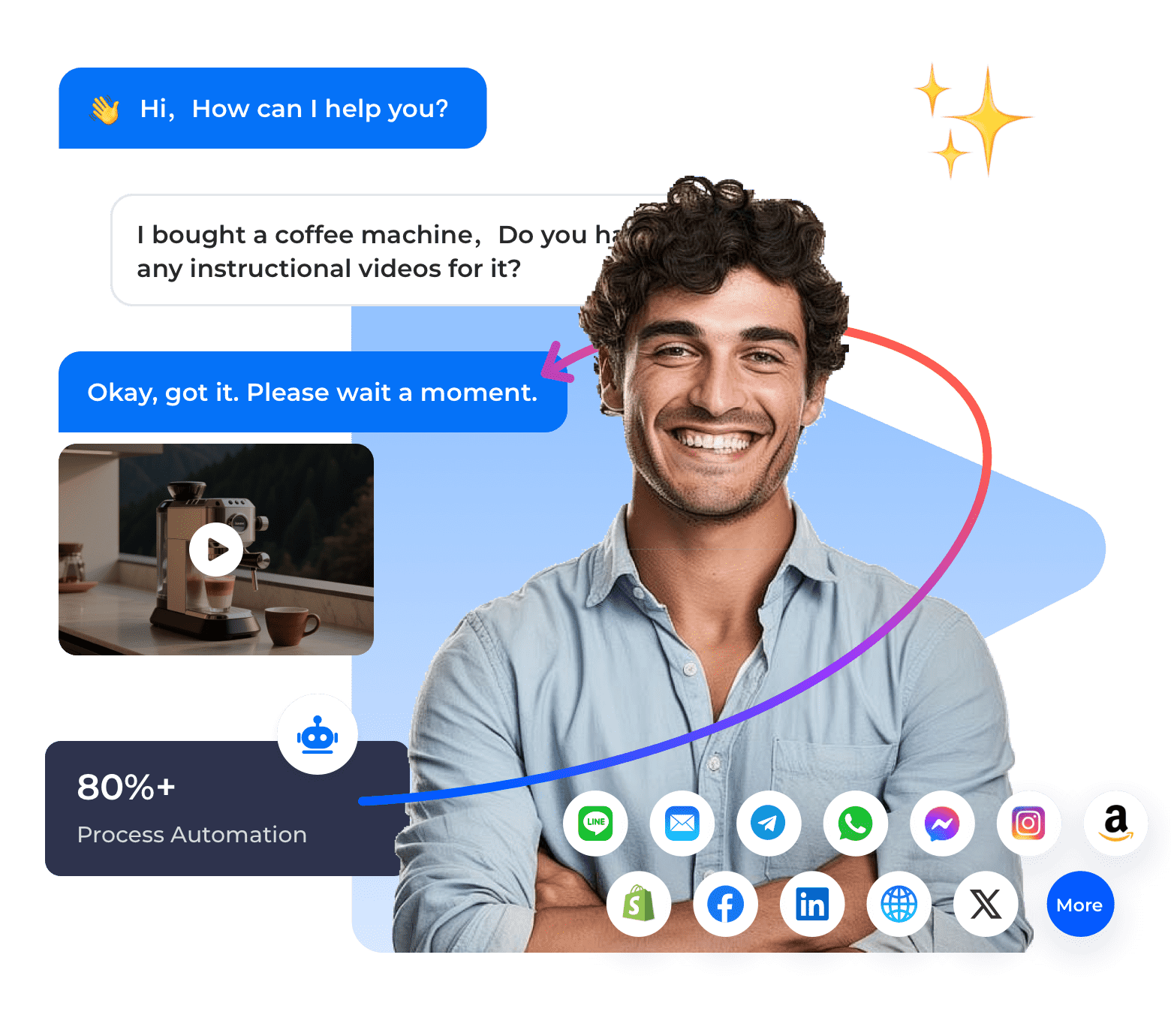
Digital employees are the service skills brought by artificial intelligence. They can communicate with customers by themselves and help agents work. The Southeast Asian market is growing very fast. Enterprises here face a lot of scattered platforms. There are many users who speak different languages here, and the service requirements are getting higher and higher. Digital employees have become a very effective method. Instadesk's chatbot
scheme supports enterprises to scale up their business without adding people. They are not only simple reply, but service participants who are always online.

1. What is a Digital Employee?
A Digital Employee is a combination of AI chatbot capabilities, workflow automation, and system integration that allows businesses to simulate and extend human service capacity.
Within Instadesk, the chatbot acts as a core Digital Employee by handling repetitive conversations, accessing knowledge bases, and assisting users in real time. In actual deployments, text-based bots are available 24/7 and rely on natural language understanding to respond to large volumes of standardized inquiries, ensuring that customers receive immediate and accurate answers without waiting for human intervention.
What makes it different from a standalone tool is that it operates inside a broader system, meaning it is not just answering questions, but actively participating in service delivery.
2. Digital Employee vs Traditional Chatbot
The difference between a Digital Employee and a traditional chatbot lies in capability and role.
Traditional chatbots are typically limited to scripted replies and cannot go beyond predefined logic. A Digital Employee, especially when built on Instadesk, works within an integrated environment where it can access customer data, trigger workflows, and collaborate with human agents.
For example, instead of simply replying to a customer question, a Digital Employee can identify intent, retrieve relevant knowledge, and ensure the request is properly handled within the system. This shift turns the chatbot from a passive responder into an active participant in the service process.
3. Why Digital Employees Matter
The business is going to Southeast Asia and other places. The three troubles of manual management have become more difficult to deal with. The channels are too scattered. There are too many people consulting. Everyone wants to get it back immediately. Digital employees directly solve these troubles.
Many service channels are placed in a unified platform. Customer communication is integrated. Artificial intelligence began to process requests. The company's efficiency has been improved by 50%. It's not just a matter of speed. This can reduce the operational friction caused by the system change, and also reduce the operational friction generated by the management of scattered information. Artificial intelligence chatbots provide support around the clock. There is much less delay during off-peak hours. The delay across time zones is much less. In practice, the night service was delayed by 80%. Customers can get a quick response no matter when they come.

4. How to Use Digital Employees
Adopting Digital Employees does not require replacing existing teams. Instead, it involves restructuring how work is distributed between humans and AI.
The first step is to centralize all customer interactions into a single platform like Instadesk. When inquiries from websites, apps, social media, and email are brought together, Digital Employees can operate efficiently without losing context.
Next, deploy chatbot capabilities to handle repetitive and high-frequency queries. This allows human agents to focus on more complex or sensitive cases.
Finally, ensure that the Digital Employee is connected to internal systems such as knowledge bases and ticketing workflows. When properly integrated, it can not only answer questions but also support resolution by guiding customers and assisting agents behind the scenes.
5. Enhancing Efficiency with Instadesk AI Tools
Instadesk's robots have truly turned the idea of digital employees into hands-on and energy-based physical objects.
Its omni-channel access allows the company to manage all customer contact points with only one interface. This practice drives away the inefficiency caused by the mess of multiple systems. The robot kept processing a large number of repeated questions there. This ensures that customers don't have to queue up when there are many people.
There is a well-organized knowledge base behind it. The answer has always been very stable and accurate. This is especially important for maintaining the quality of service on a large scale. The system also allows AI to work well with manual seating. If you encounter any trouble, you can directly transfer it to manual handling. The overall experience was not affected at all.
This practice of automatic work and mutual cooperation allows digital employees to take off with real efficiency. This is not the kind of small progress.
6. Frequently Asked Questions
Will a Digital Employee replace human agents?
No. It is designed to reduce repetitive workload and support agents, not replace them. Human teams remain essential for complex, emotional, or high-value interactions.
How quickly can results be seen?
In high-volume environments, improvements in response time and efficiency can be observed relatively quickly once chatbot automation and channel integration are in place .
Is it suitable for multilingual markets like Southeast Asia?
Yes. Digital Employees are particularly valuable in regions with diverse languages and platforms, as they can standardize responses and reduce dependency on large multilingual teams.
Does it only handle simple queries?
While it is highly effective for repetitive inquiries, it also supports broader workflows by assisting with routing, information retrieval, and agent collaboration.
7. Conclusion

Digital Employees represent a shift in how customer service is delivered. Instead of relying solely on human capacity, businesses can combine AI chatbot capabilities with integrated systems to create a scalable, always-on service model.
With Instadesk, the chatbot is not an isolated feature but a core part of a larger service infrastructure. It enables faster responses, reduces operational pressure, and ensures that customer experience remains consistent even as businesses grow across regions.
In a market where speed, accuracy, and availability increasingly define service quality, Digital Employees are becoming less of an option and more of a necessity.