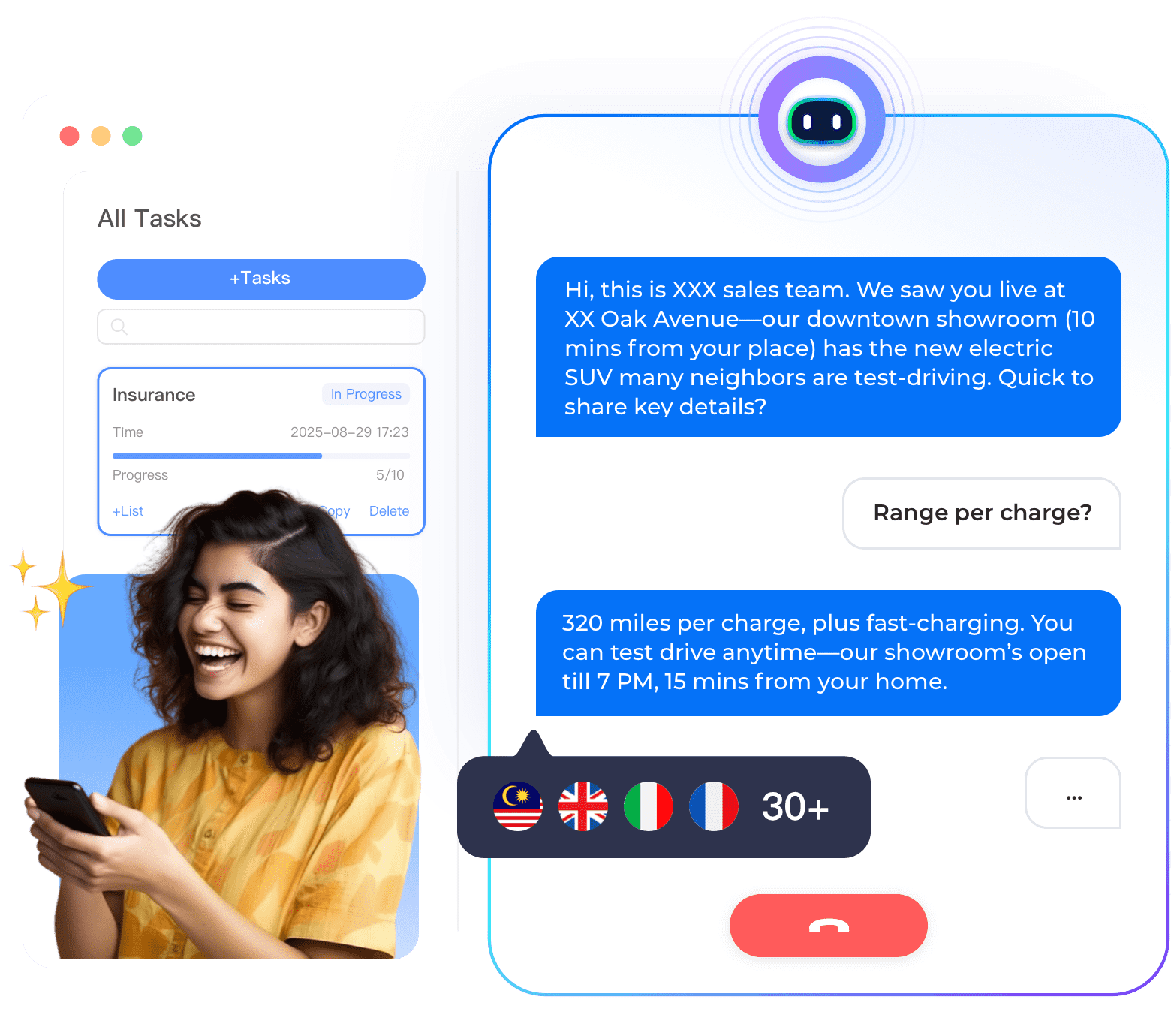

In the insurance world, the "mechanical response" is more than a nuisance—it is a business bottleneck. When a customer mentions, "My financial products just expired," a traditional system misses the signal. A modern
Voice bot
, however, immediately recognizes a cross-selling opportunity. This isn't a futuristic concept; it is the current standard for industry leaders.As the intelligent outbound market surpasses 28.5 billion yuan with a 31.4% growth rate, the gap between traditional methods and AI-driven engagement is widening. With average conversion rates for traditional overseas calls hovering below 8%, the industry is turning to high-concurrency Voice bots to bridge the divide.
The Efficiency Wall: Why Traditional Calls Fail
Manual outbound calling has hit a ceiling. Operations are currently trapped by four core challenges:
·
Human Limitations:
An agent can handle roughly 300 calls a day, but only 35% of that time is spent in actual conversation. The rest is lost to dial tones and invalid numbers.·
The 30-Second Hurdle:
Script-based calls feel robotic. Most are hung up within 30 seconds, leading to a "failed touchpoint" where no data is gathered.·
Complexity Mismatch:
Insurance products require nuance. Static scripts cannot handle complex consultations, often leading to missed emotional cues and lost business.·
The Compliance Gap:
Manual quality checks cover less than 5% of calls, leaving companies exposed to significant regulatory risks.
The AI Breakthrough: Dialogue Intelligence
The transition to
Voice bots
powered by Large Language Models (LLMs) has redefined communication standards through three key pillars:1.
Precise Intent Recognition:
By integrating ASR and NLP, Voice bots now reach93.5% intent accuracy
. Unlike older systems limited to two rounds of dialogue, modern bots sustain 8–12 rounds of natural conversation.2.
Human-Level Synthesis:
Using advanced TTS, these bots achieve a "real-human" voice quality (MOS score of 4.5). This allows companies to clone the voices and personas of their top-performing agents at scale.3.
Agent-Driven Decision Engines:
These aren't just programs; they are dynamic assistants. Multi-agent architectures allow the bot to adjust strategies in real-time based on customer sentiment, resulting in completion rates3.2 times higher
than legacy systems.
Quantitative Change: The Power of High Concurrency
High-concurrency isn't just about volume; it’s about evolution. When a system handles millions of calls daily, every interaction acts as a "data probe."
·
The Risk Radar:
By analyzing microscopic signals—tone fluctuations, hesitations, and keywords—Voice bots extract "risk profiles" from massive datasets. One institution reported a50% increase in call duration
and a30% boost in conversions
by leveraging these insights.·
Stability at Scale:
Distributed architectures ensure that even at 12 million calls per day, the service remains smooth. Each node handles hundreds of concurrent lines, ensuring no latency in the "thinking" process of the AI.
Practical Application: Four Winning Scenarios
The versatility of the
Voice bot
is best seen in its operational impact:
Conclusion: From Tool to Strategic Partner
The era of the "dialing machine" is over. Today's
Voice bot
is a core strategic asset that integrates into the digital ecosystem of an insurance firm. It has evolved from a passive tool into a proactive partner that provides deep customer insights and manages risk in real-time.For insurance enterprises, the choice is clear: continue with manual bottlenecks or embrace the scale and intelligence of AI-driven communication.