Voicebot for customer service: what it means and how it helps
In today's fast-paced digital landscape, customers expect immediate, personalized responses across every communication channel. According to Intercom's 2026 Customer Service Transformation Report, 87% of senior leaders plan to invest in AI for customer service in 2026, with 77% of CS teams reporting that AI is meeting or exceeding their expectations. This shift is driving organizations toward conversational AI at unprecedented scale.
For businesses looking to meet these rising expectations, voicebot AI solutions have emerged as a game-changing technology. VoiceBot represents the next generation of AI voicebot technology—combining large language models with natural conversation capabilities to transform how companies handle customer interactions. Whether for outbound sales, customer service, or follow-up notifications, voicebots are revolutionizing contact center operations globally.
This article explores how VoiceBot leverages conversational AI to deliver measurable business results, and why it's becoming an essential tool for modern customer service teams.

What is VoiceBot?
VoiceBot is a multi-language, large-model powered AI bot designed to automate and enhance customer conversations. Unlike traditional interactive voice response (IVR) systems that force customers through rigid menu trees, Voicebot AI understands natural language, conducts multi-round conversations, and responds with human-like emotion and intonation.
The technology combines two critical components:
• Natural Language Processing (NLP) : Analyzes speech patterns to decipher meaning, accommodating accents, grammatical variations, and local communication habits across multiple languages including Malay and English
• Large Language Model Integration: Powers contextual understanding and generates personalized responses in real-time, learning from each interaction to continuously improve
How Voicebots Work
Modern AI voicebots operate through a coordinated architecture of several key components working in real-time:
• Large Language Model (LLM): Serves as the reasoning engine, understanding user intent and generating appropriate responses. LLMs handle everything from simple questions to complex operations involving external tools like booking systems, CRM databases, and payment processors.
• Text-to-Speech (TTS): Converts the LLM's text output into natural-sounding spoken responses. Modern TTS systems deliver sub-200ms time-to-first-byte, ensuring conversational flow remains natural.
• Orchestration Layer: Coordinates the entire pipeline, managing streaming audio, handling interruptions, routing tool calls, and keeping all components synchronized in real-time.
The most successful implementations maintain modularity—using separate, optimized components for each function rather than end-to-end speech-to-speech models. This approach provides critical observability, allowing teams to inspect transcripts, identify failure points, and continuously improve performance.
Key Use Cases for Voicebots
Voicebots deliver measurable results across diverse industries. Understanding core application categories helps organizations identify where voice AI creates greatest impact.
1. High-Volume Customer Service and Support
This represents the most common entry point. Organizations deploy voicebots to handle routine inquiries about order status, account information, business hours, and policies. These implementations prioritize high concurrency, low latency, and cost control through hybrid architectures—using cost-effective models for frequent questions while reserving sophisticated LLMs for complex queries.
2. Business Transaction and Self-Service
The current frontier moves beyond Q&A to enable transaction processing. Voicebots handle appointment scheduling, reservation changes, order modifications, and account updates by integrating directly with backend systems. Success requires deep integration—querying databases, validating information, and executing transactions via APIs.
3. Outbound Engagement and Proactive Service
Voicebots excel at appointment reminders, payment collection, surveys, and marketing outreach. Deployments must incorporate compliance guardrails including consent verification, opt-out mechanisms, and clear AI disclosure. Modern approaches use "service-wrapped" framing and A/B testing to optimize conversion rates.
4. Sensitive and High-Emotion Interactions
For complaint handling, service disruptions, or debt collection, voicebots incorporate emotion recognition detecting stress from vocal patterns. When thresholds exceed limits, systems provide seamless handoff to human agents with complete conversation context—eliminating customer repetition.

Voicebot Benefits for Modern Enterprises
1. Dramatic Cost Savings
The financial case for voicebot AI is compelling. By automating routine customer interactions, businesses significantly reduce labor costs while maintaining 24/7 availability. Gartner projects conversational AI will reduce contact center agent labor costs by $80 billion by 2026. Industry analysis shows fully-managed voice AI platforms cost $0.05 to $0.15 per minute—substantial savings compared to human agent expenses.
2. Enhanced Customer Experience
Today's consumers expect personalized interactions—71% consider personalization a basic expectation, and 76% become frustrated when it doesn't happen, according to McKinsey. Modern voicebots deliver personalization by identifying customer intent in real-time, detecting emotional states from vocal patterns, maintaining natural conversation flow, and providing consistent information across every interaction.
3. Operational Efficiency and Scalability
Voicebots provide round-the-clock service, handling thousands of simultaneous calls during peak periods without degradation. This scalability benefits businesses serving global customers across time zones or managing seasonal demand spikes. Contact centers implementing voice AI see measurable improvements in issues resolved per hour and reduced average handling time.
4. Data Security and Compliance
Customer service handles sensitive information, making security paramount. Enterprise voice solutions must incorporate data encryption, secure transmission protocols, and compliance with regulations like GDPR and CCPA. Pre-installed compliance guardrails ensure conversations remain within regulatory boundaries.
A Solution Example: Instadesk VoiceBot
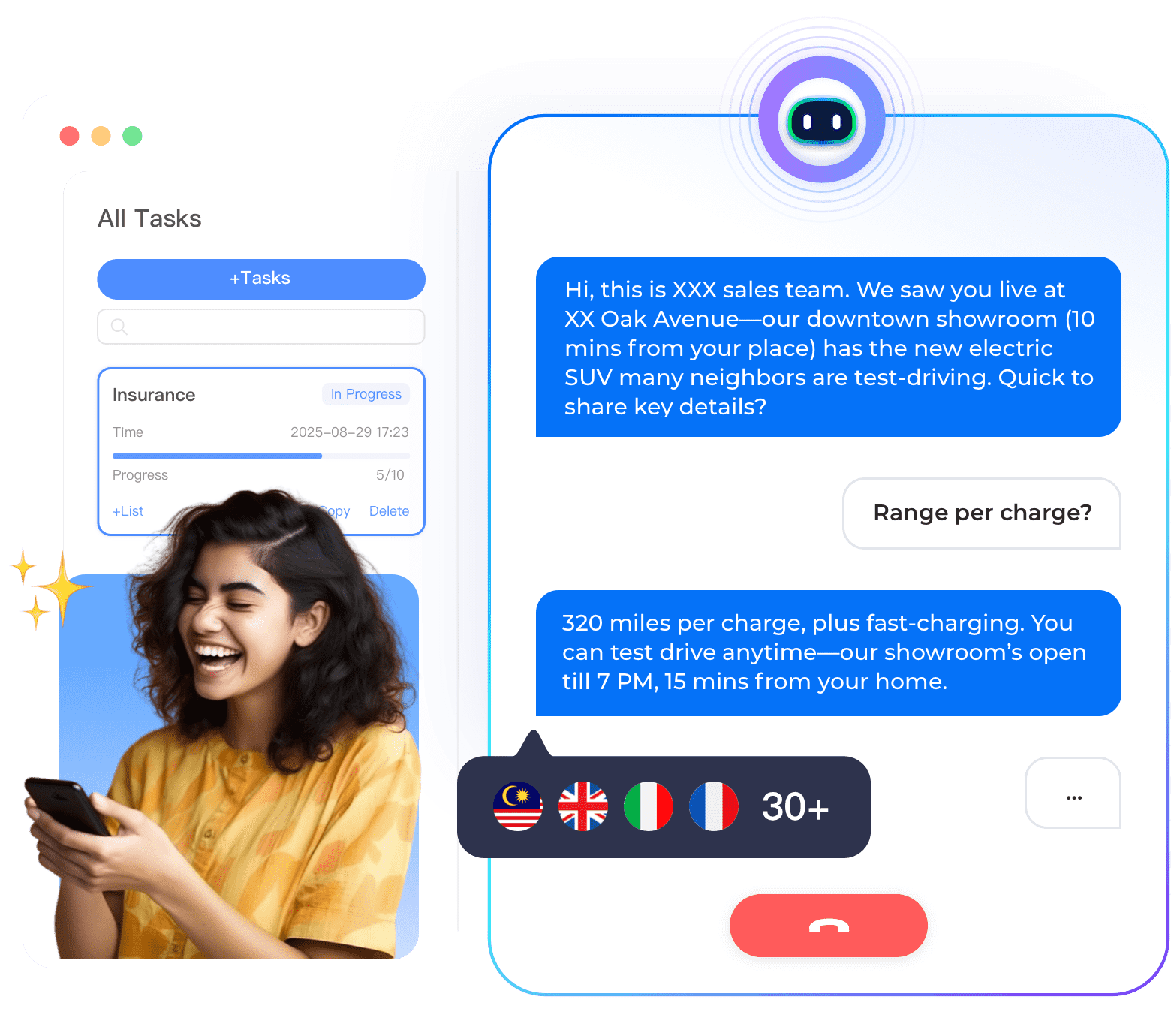
Organizations using Instadesk report 60% or greater reductions in manual costs while expanding outreach capacity. The platform's zero-code visual orchestration and ASR/TTS support for over 30 languages enable multilingual campaigns with minimal investment. For security, Instadesk implements desensitized data storage, call link encryption, flexible deployment options, and pre-installed compliance systems—increasing data security by 60% while reducing business violation rates by 40%. The drag-and-drop interface and pre-configured templates allow businesses to build and iterate voicebots three times faster than traditional approaches.
The Future of Customer Service: AI and Human Collaboration
Conversational AI supercharges customer service workflows, but it works best alongside skilled professionals. Instadesk VoiceBot handles the heavy lifting—routine inquiries, initial qualification, follow-up notifications—freeing human agents to focus on complex issues requiring empathy, creativity, and strategic thinking.
This winning combination delivers the scalability of automation with the nuance of human interaction. As AI technology continues advancing, the organizations that thrive will be those that effectively integrate voicebot AI into their customer service operations while maintaining the human touch that builds lasting customer relationships.
Tags
Share This Article


Instadesk
Instadesk official
You may also like

Cost-Effective AI Voice Bots 2026:A Complete Buyer's Guide
AI voice bots have moved from experimental technology to operational necessity. In 2026, businesses of all sizes are deploying voice AI to handle customer support calls, book appointments, qualify leads, and run outbound campaigns. But with pricing ranging from $0.07 per minute to $160 per agent per month, and a growing list of providers, finding a truly cost-effective solution isn't straightforward.


Indonesia Financial Industry Debt Collection Reminder VoiceBot Solution: Boost Collection Efficiency by 35%, Cut Operating Costs by 60% with AI VoiceBot
Indonesia is one of the largest economies in Southeast Asia, and its financial services sector is expanding rapidly. As of February 2026, total online loan debt in Indonesia reached Rp100.69 trillion (approximately $6.5 billion), up 25.75% year-on-year. Meanwhile, OJK data shows that the non-performing loan (NPL) ratio in the MSME sector is trending upward, reaching 4.55% in March 2026. The default rate for fintech P2P lending remains at 2.77%.

What Is a Voice Bot with Data Security Compliance?A Guide for Philippine Financial Services
Financial institutions in the Philippines are adopting voice bots to automate customer calls,but data security and compliance with the Data Privacy Act(DPA)of 2012 and BSP regulations are paramount.A voice bot with data security compliance ensures that all customer conversations are encrypted,access is controlled,and audit trails are maintained.This article defines compliant voice bots,explains how they differ from standard bots,highlights their importance for Philippine financial services,and demonstrates how Instadesk’s platform meets local security requirements.

Get Started in Minutes. Experience the Difference.




WhatsApp Us Now !