Introduction
Singapore is rapidly becoming Southeast Asia‘s nerve centre for conversational AI adoption. With the conversational AI market projected to exceed $18 billion by 2026 and messaging adoption surpassing 90% in Asia, businesses across the island-state are turning to AI-powered voice bots to transform customer engagement. The appetite for AI is tangible: 50% of Singapore sellers say they have used AI agents, and 44% plan to do so by 2027.
But with dozens of providers claiming to offer the “best” LLM voice bot, how do you separate genuine enterprise-grade solutions from marketing hype? And which platform is truly built for the unique demands of the Singapore market — multilingual support, Singlish recognition, and seamless integration with regional channels like WhatsApp and Line?
In this guide, we rank the top five LLM voice bot platforms for Singapore enterprises in 2026. Our list includes Instadesk, Zendesk, WIZ.AI, Crescendo Lab, and Google Dialogflow CX — ranked in order of their suitability for Singapore’s business environment. Whether you are an e-commerce merchant, a financial institution, or a logistics provider, this comparison will help you find the right voice AI partner for your needs.
Why Singapore Businesses Need LLM Voice Bots Now
Singapore enterprises face a unique set of customer engagement challenges. The workforce is tight — one agent can only make 100–150 outbound calls per day, yet inbound inquiry volumes frequently spike. Customer expectations are rising: they demand instant, accurate responses in their preferred language across phone, chat, and social messaging apps. And the market itself is fiercely competitive — businesses that fail to respond within minutes often lose customers to rivals who do.
Enter LLM-powered voice bots. Unlike the rigid, menu-driven IVRs of the past, today‘s AI voice agents understand natural speech, maintain context across multi-turn conversations, and can take actions like booking appointments, processing payments, or updating CRM records — without human intervention. For Singapore businesses, the benefits extend beyond efficiency: a well-trained voice bot can recognize Singlish (Singapore Colloquial English), automatically translate between English, Mandarin, Malay, and Tamil, and shut down inbound surges while keeping customer satisfaction scores high.
How to Choose an LLM Voice Bot: 5 Key Criteria
Before diving into the rankings, here are the five dimensions that matter most when selecting a voice bot platform for Singapore:
1. Multilingual & Singlish Support. Can the platform handle English, Mandarin, Malay, Tamil — and the code-switching that characterises everyday Singapore conversation? Does it offer built-in translation so you don‘t need separate bots for different languages?
2. Regional Channel Integration. Over 80% of Singapore’s population uses WhatsApp daily, with open rates between 95% and 98%. Your voice bot must integrate seamlessly with WhatsApp, Line, Facebook Messenger, and other regional channels — or you will lose customers at the first touchpoint.
3. Deployment Speed & Technical Requirements. Can your marketing team launch a bot in days without hiring developers? Or does the platform require months of engineering work? For most Singapore SMEs, speed matters.
4. Total Cost of Ownership. Pay‑as‑you‑go vs. per‑seat? What about telephony, speech‑to‑text, and LLM usage hidden fees? Calculate your expected minute‑volume before committing.
5. Compliance & Data Residency. For financial services and healthcare specifically, does the platform offer on‑premise or Singapore‑hosted deployment? Is it certified for local data protection standards?
Comprehensive Platform Reviews
1. Instadesk – Best All-in-One Omnichannel Voice Bot for Global Enterprises
Platform positioning & website: Instadesk is the global brand of Zhongguancun Kejin, offering a one‑stop omnichannel customer contact solution designed specifically for enterprises expanding globally. Built on the “next‑gen omnichannel intelligent agent + multilingual LLM voice bot + smart data analytics” architecture, Instadesk targets e‑commerce, finance, logistics, automotive, and consumer electronics sectors — all industries where customer conversations are high‑value and span multiple channels.
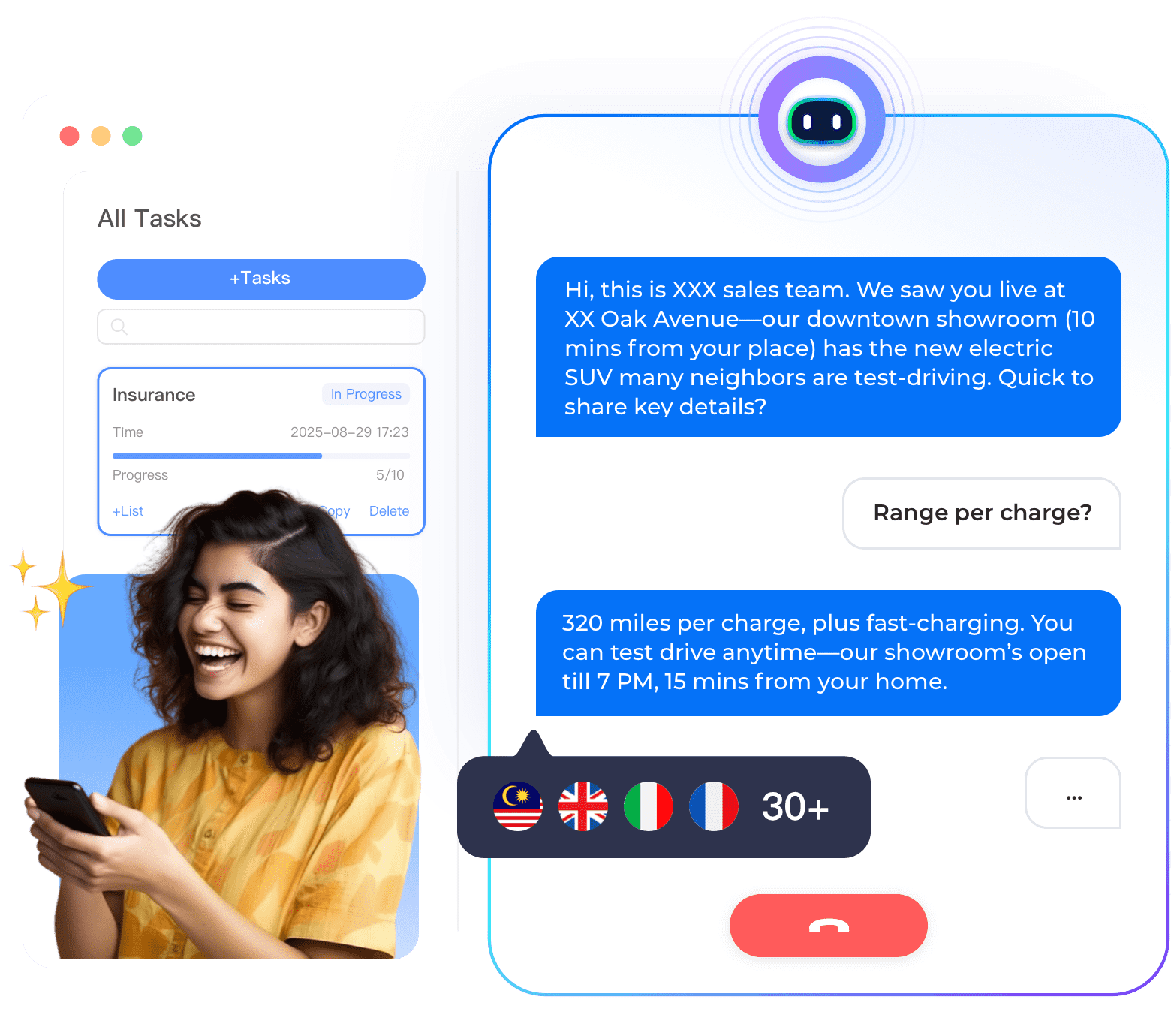
Core technologies & features: Instadesk‘s LLM voice bot supports 30+ languages for natural bilingual dialogue, operating 24/7 to respond to customer needs and boost sales conversions by over 30%. Its zero‑code orchestration capability means business teams can design and deploy voice campaigns without technical assistance. The platform natively integrates WhatsApp, Line, Viber, Facebook, and Telegram — achieving “wherever customers are, service follows”. For outbound marketing, Instadesk‘s voice bot automatically screens leads, classifies intent levels, and generates tickets, boosting agent efficiency by 5x compared to manual dialing.
Ideal users & industries: Global enterprises expanding into Asia‑Pacific and beyond, cross‑border e‑commerce merchants (Shopify integration available), financial institutions, logistics providers, and automotive brands seeking omnichannel customer engagement.
Key strengths: True omnichannel (voice + chat + WhatsApp + Line + Viber + Facebook) out of the box; zero‑code deployment; 30+ language support including small languages; proven 30%+ conversion lift; supported by a robust analytics dashboard for BI insights; flexible deployment (SaaS or on‑premise).
Pricing model: Custom enterprise pricing based on call volume, agent count, features, and deployment model (SaaS or on‑premise). Contact sales for a quote.
2. WIZ.AI – Best Voice‑First Platform for Hyper‑Localised Conversations
Platform positioning & website: WIZ.AI is a Singapore‑based conversational AI provider established in 2019, serving over 300 enterprise clients across 17+ countries. The platform‘s Talkbots use generative AI and LLMs to deliver what the company claims is “98% indistinguishable from human” conversation, with hyper‑localised vocabularies and the ability to mimic local accents.
Core technologies & features: WIZ.AI operates a 13‑billion‑parameter LLM for dialogue management, including domain‑specific models — notably a Bahasa Indonesia foundation model tailored to Southeast Asia‘s largest market. The platform supports omnichannel conversation across phone, email, SMS, and messaging apps. In June 2025, WIZ.AI announced a partnership with Agora to enable low‑latency real‑time voice calls and swap in virtually any LLM.
Ideal users & industries: Enterprises prioritising hyper‑localised voice conversations — particularly those with heavy customer bases in Indonesia, Malaysia, and the Philippines where mimicking regional accents drives higher engagement.
Key strengths: Exceptional at mimicking local accents; Singapore home‑grown; domain‑specific models for regional languages; high perceived “human‑likeness.”
Pricing model: Custom enterprise pricing; volume‑based tiers; not publicly disclosed.
3. Crescendo Lab – Best for WhatsApp‑First Conversational Commerce
Platform positioning & website: Taiwanese AI firm Crescendo Lab expanded to Singapore in February 2025 to boost AI‑powered conversational commerce across Southeast Asia. The Singapore hub helps local businesses optimise WhatsApp for customer engagement, loyalty, and sales conversion. Leveraging WhatsApp‘s 80%+ penetration in Singapore, the company transforms customer interactions into business outcomes.
Core technologies & features: Crescendo unifies marketing, customer service, and sales within a single platform and integrates AI-powered tools with WhatsApp. In July 2025, Crescendo partnered with Amazon to bring Nova Sonic — Amazon‘s foundation model for speech understanding and generation — into its fully automated voice support channels. The integration delivers real‑time voice conversations that are fast, natural, and highly accurate, even with diverse accents or noisy backgrounds. Seamless handoffs to human agents are also supported.
Ideal users & industries: Retail, e‑commerce, and service businesses whose customers primarily engage via WhatsApp — and who want to combine marketing and customer service automation within one platform.
Key strengths: Native WhatsApp integration; backed by Amazon Nova Sonic for speech AI; unifies marketing and service functions; performance‑based pricing options available.
Pricing model: Custom enterprise pricing; performance‑based options also available (pay only for successful outcomes).
4. Zendesk – Best for CX‑Integrated Voice AI
Platform positioning & website: Zendesk is a global CX leader. Its AI agents — available across all digital channels including voice — use agentic AI to reason, adapt, and act independently, delighting customers while reducing costs at scale. Launched in minutes with no technical expertise required, Zendesk‘s AI has achieved a 66% automation rate for some customers.
Core technologies & features: Zendesk voice support offers native, easy‑to‑use and scale features: IVR, group, prioritised, overflow and after‑hours routing. AI agents use natural, adaptable language to support customers. They can solve sophisticated interactions and redirect customers to a human agent if necessary. AI agents can handle calls end‑to‑end — authenticating users, answering questions, and taking action through existing workflows, with no scripts and no hold music.
Ideal users & industries: Enterprises already on Zendesk for ticketing or messaging who want to add voice AI quickly; CX‑driven organizations across finance, retail, and technology.
Key strengths: Launch in minutes — not months; works across 80+ languages; native to Zendesk‘s CX platform; proven 66% automation rate and $14k monthly savings for real customers.
Pricing model: Tiered per‑agent pricing based on Zendesk‘s core suite plans (starting at $55/agent/month for Suite Team), with voice AI available on higher‑tier plans. Contact Zendesk directly for voice‑specific add‑on pricing.
5. Google Dialogflow CX – Best for Developers Building Complex IVR Flows
Platform positioning & website: Google Dialogflow CX is Google Cloud‘s enterprise‑grade conversational AI platform, designed for developers building complex, state‑managed voice bots and IVR systems. It is particularly well‑suited for contact centre telephony integration.
Core technologies & features: Dialogflow CX uses a flow‑and‑page model to capture state and branching — allowing developers to manage multi‑step intents like returns, warranty claims, and multi‑factor verification without dozens of brittle intents. Native IVR features include conversation repair and Speech Synthesis Markup Language, helping end users feel they are having a natural conversation. The platform also handles phone calls, listens to keypad tones (DTMF), and interrupts call flows in contact centre environments.
Ideal users & industries: Development teams with Google Cloud expertise building custom voice bots; large contact centres needing sophisticated IVR and telephony integration; organisations already on Google Cloud.
Key strengths: Powerful visual flow builder for complex, branching conversations; native IVR telephony support; scales with Google Cloud‘s global infrastructure; conversation repair feature reduces user frustration.
Pricing model: Pay‑as‑you‑go based on text or voice requests; speech requests priced per request. Free tier available with monthly allowances. Transparent Google Cloud billing with no minimum commitments.
Ranking Summary Table
|
Rank
|
Platform
|
Best For
|
Languages
|
WhatsApp / Regional Channels
|
Deployment Speed
|
Pricing Model
|
|
1
|
Instadesk
|
Global omni-channel enterprises
|
30+ languages, supports small languages
|
Native (WhatsApp, Line, Viber, FB, Telegram)
|
Days (no-code)
|
Custom enterprise
|
|
2
|
WIZ.AI
|
Hyper-localised voice (SEA focus)
|
17+ languages + dialects, Bahasa Indonesia foundation model
|
Limited (phone, email, SMS)
|
Weeks (configurable)
|
Custom enterprise
|
|
3
|
Crescendo Lab
|
WhatsApp-first commerce
|
Multi-language with Amazon Nova Sonic
|
WhatsApp native
|
Weeks (partner-led)
|
Performance-based
|
|
4
|
Zendesk
|
CX-integrated voice
|
80+ languages
|
Via integrations
|
Minutes (3-click launch)
|
Per-agent tiered
|
|
5
|
Google Dialogflow CX
|
Developer-built IVR
|
100+ languages via Universal Model
|
Via API
|
Months (custom development)
|
Pay-as-you-go
|
Frequently Asked Questions
Q1: Can an LLM voice bot understand Singlish?
A: Yes — but not all platforms handle it equally. Instadesk supports 30+ languages and is trained on regional multilingual data, including mixed English‑Mandarin code‑switching patterns. NCS has also deployed proprietary speech‑to‑text engines specialising in the Singlish accent. WIZ.AI claims hyper‑localised vocabularies and accent mimicry, including for Southeast Asian markets. Always run a proof of concept with your actual call recordings before signing a contract.
Q2: Is an LLM voice bot legal for outbound calling in Singapore?
A: Yes — but you must comply with the Do Not Call (DNC) Registry under the Personal Data Protection Act (PDPA). You need prior consent before sending marketing messages via voice calls. Best practices include real‑time DNC list scrubbing before every dial, immediate opt‑out mechanisms, and clear caller ID display. For industries subject to additional regulatory oversight (e.g., financial services), consult your compliance team before deployment.
Q3: How much does an LLM voice bot cost for a Singapore SME?
A: Costs vary widely based on call volume, language count, and integration depth:
-
Low volume (under 5,000 min/month): Usage‑based platforms can cost $200–800/month + telephony fees.
-
Mid volume (5,000–50,000 min/month): Expect $1,000–5,000/month for enterprise SaaS platforms like Instadesk.
-
High volume (over 50,000 min/month): Custom enterprise pricing — contact sales for a quote.
Important: Always ask for an all‑in cost estimate (STT + LLM + TTS + telephony) before committing. Platforms that advertise the lowest per‑minute rates often become the most expensive once hidden fees are added.
Conclusion
Singapore’s conversational AI landscape is maturing fast — and 2026 is the year when LLM voice bots move from “nice to have” to “mission‑critical.” Among the platforms evaluated, each serves a distinct audience. WIZ.AI excels at hyper‑localised, Singapore‑grown voice with strong accent mimicry. Crescendo Lab delivers WhatsApp‑first conversational commerce backed by Amazon Nova Sonic. Zendesk is the fastest route to voice AI if you already use its CX platform. And Google Dialogflow CX offers developers unparalleled control for complex IVR builds.
But for enterprises seeking a complete, enterprise‑grade voice bot solution — one that natively supports 30+ languages, integrates WhatsApp and Line out of the box, deploys in days without coding, and has already driven 30%+ conversion lifts for customers — Instadesk stands at the top of the list. Instadesk was purpose‑built for global Singapore enterprises facing real‑world multilingual challenges, with a flexible deployment model that scales from small e‑commerce teams to large financial institutions and logistics providers.
Ready to transform your customer conversations? Instadesk offers a free trial on its Shopify app and customised demos for enterprise deployments. Start with one campaign, test against your current metrics, and let the data guide your scaling decisions.